
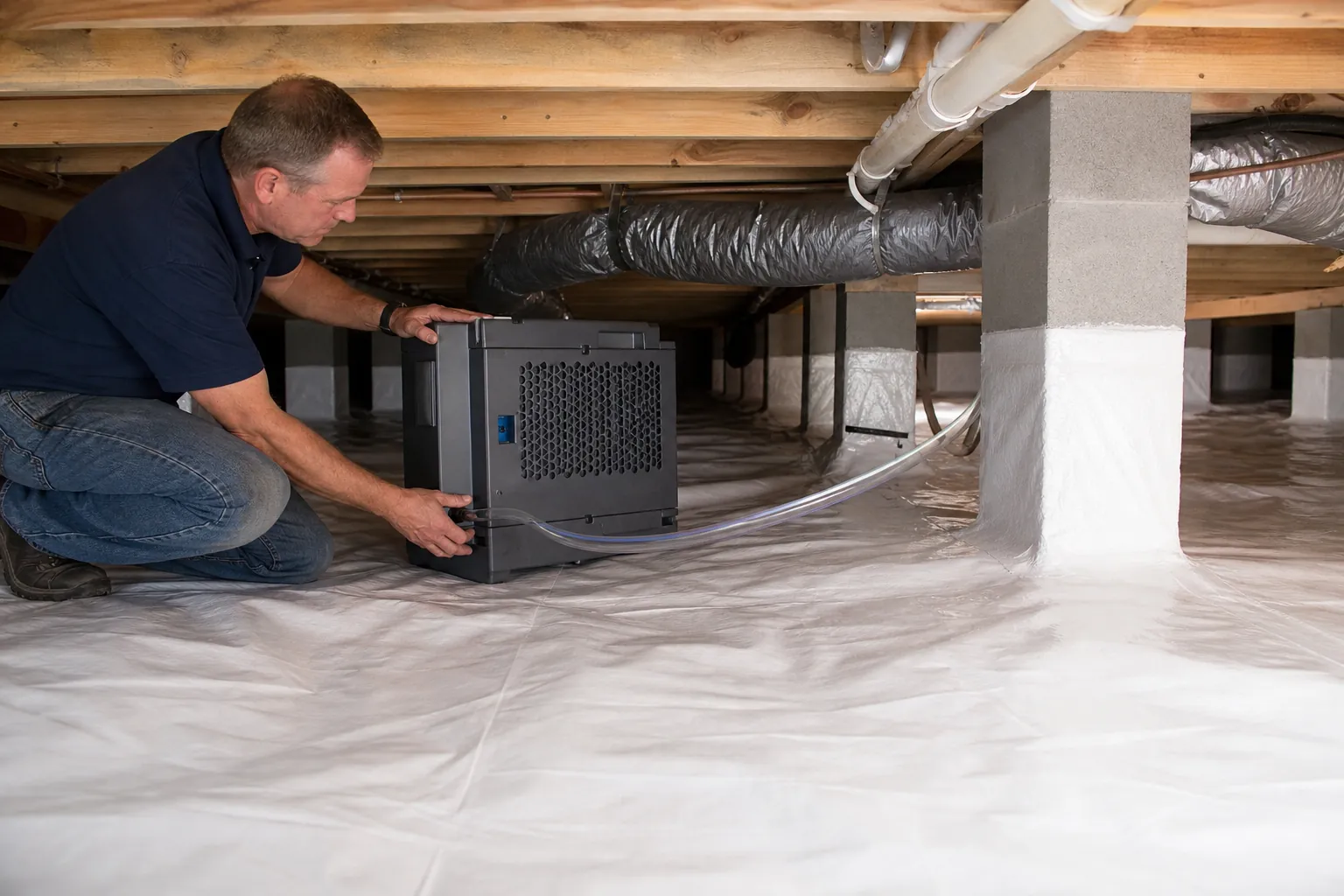
A crawl space dehumidifier should be large enough to control moisture during demanding weather without being chosen solely by the biggest number on the box. The right capacity depends on floor area, crawl space height, outside air leakage, ground moisture, temperature, and the condition of the moisture barrier.
For homeowners in Durham, NC, those details matter. Hot, humid summers can send moisture into vented crawl spaces, while red clay soils can retain water around foundations. A unit that works well in a sealed, dry crawl space may struggle in a similarly sized space with open vents and exposed soil.
This guide explains crawl space dehumidifier sizing, what to measure before choosing equipment, and why correcting moisture sources often matters more than buying a larger machine. Carolina Encapsulation Company can help evaluate the space and plan moisture control around the conditions actually present.
Why Durham Crawl Spaces Need A Site-Specific Approach
In North Carolina's humid climate, crawl space moisture is not just a result of occasional rain. Warm outdoor air carries substantial water vapor. When that air enters a cooler crawl space, its relative humidity rises, and condensation can develop on surfaces that are cold enough.
Open foundation vents do not reliably solve this summer moisture problem. They can introduce more humid air, especially when the crawl space is cooler than the outdoors. Plumbing penetrations, loose access doors, and foundation gaps provide additional pathways.
Ground moisture is another contributor. Exposed soil releases water vapor into the space above it. A thin or damaged ground cover may reduce some evaporation but still allow moisture through uncovered areas, unsealed seams, and poorly finished edges.
Red clay soils common in the region can hold water after rainfall. Poor grading, short downspout discharge paths, or inadequate drainage can keep the soil near a foundation wet. These conditions do not automatically mean a larger dehumidifier is the answer. They may indicate that water management needs attention first.
Good sizing separates normal humidity control from problems a dehumidifier should not be expected to fix. The goal is a manageable moisture load, not continuous operation against preventable water entry.
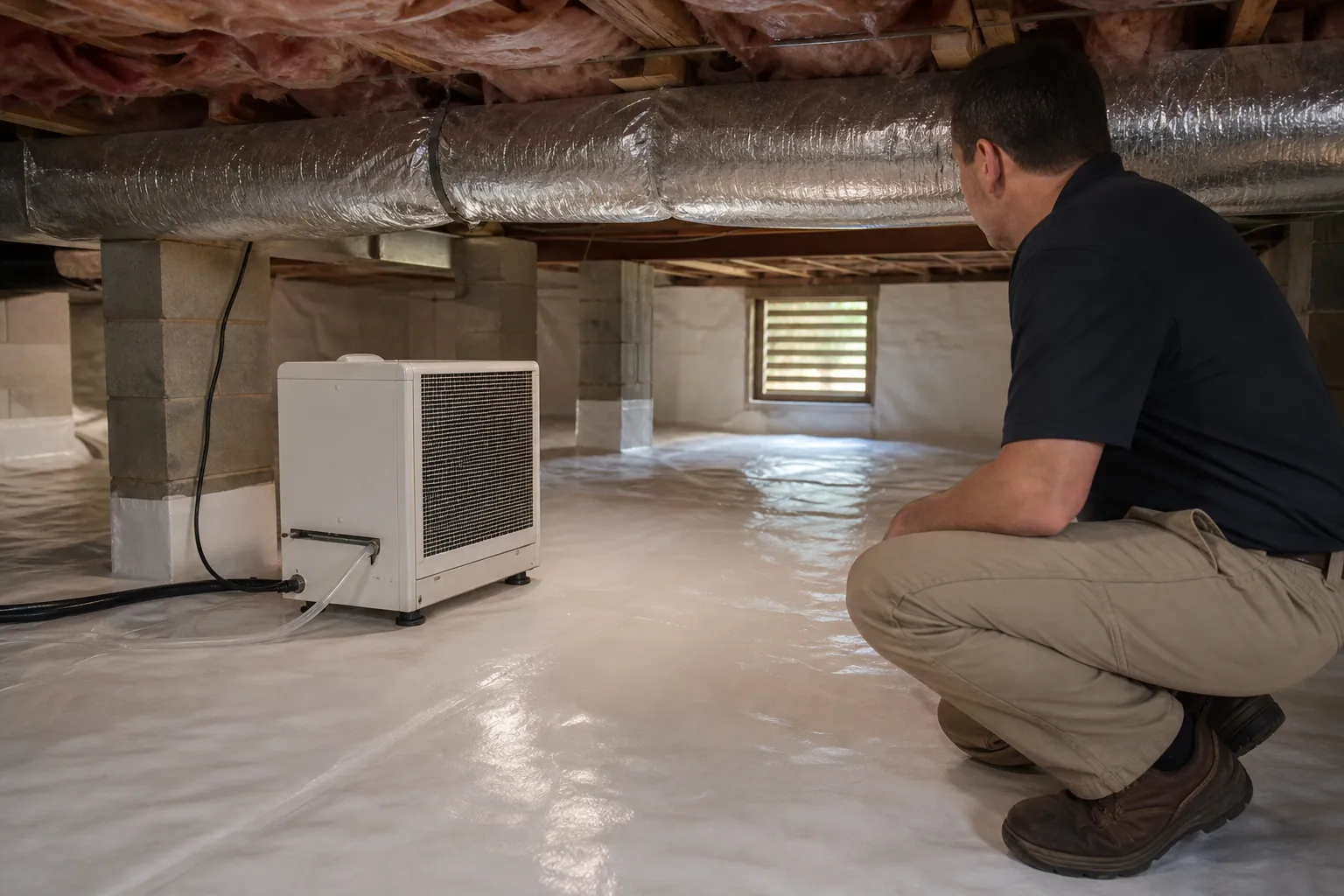
What Dehumidifier Capacity Actually Means
Dehumidifier capacity is commonly expressed as pints of water removed per day. That number describes performance under specified test conditions. It is not a promise that the equipment will remove the same amount of water every day in your crawl space.
Temperature and humidity affect water removal. A machine operating in a warm, very humid test environment may collect more water than it does in a cooler crawl space at a lower relative humidity. Compare models using the same rating basis, and check the manufacturer's performance information for conditions resembling your home.
You may also see a maximum square-foot coverage claim. Treat that as a screening tool, not a complete sizing calculation. Two crawl spaces with identical floor areas can impose very different moisture loads because one is sealed and the other exchanges air freely with the outdoors.
Airflow, usually listed in cubic feet per minute, also matters. The equipment must move enough air to treat the space effectively. Foundation walls, narrow passages, and isolated sections can limit circulation even when the unit has sufficient moisture-removal capacity.
Finally, review operating temperature limits, electrical requirements, available drain options, and service clearances. A correctly sized unit still needs to fit the crawl space and operate safely under its actual conditions.
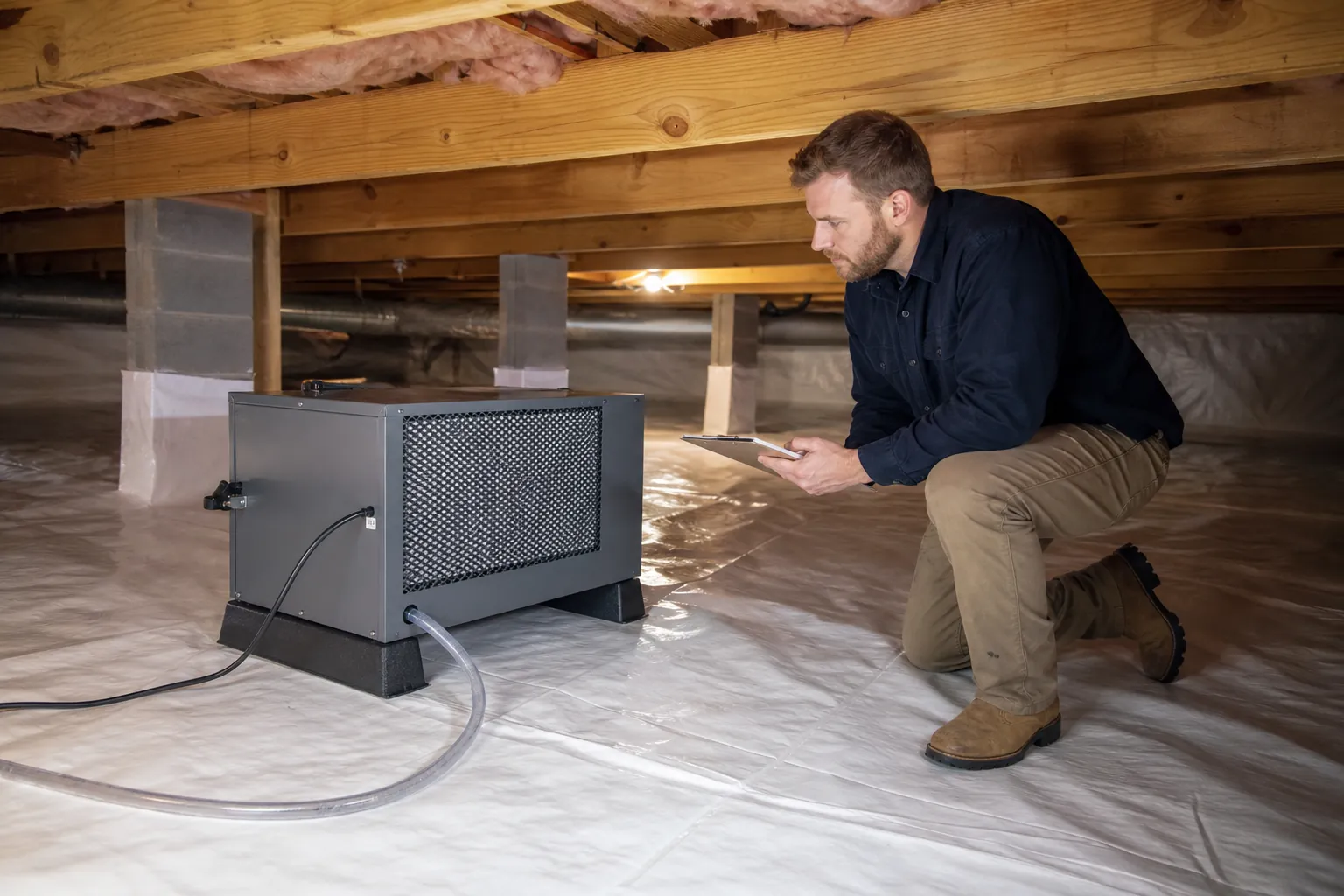
Measure The Space Before Comparing Equipment
Start with the crawl space footprint, not the home's advertised living area. A two-story home may have far less crawl space area than its total finished square footage suggests. Additions can also have separate crawl spaces that require individual evaluation.
Measure each accessible section and calculate its floor area. For a rectangular section, multiply length by width. Add the results for connected sections, and note any barriers that prevent air from moving between them.
Next, estimate average height. Multiplying area by average height gives an approximate air volume. For example, a 1,600-square-foot crawl space averaging three feet high contains about 4,800 cubic feet of air. This does not directly determine the required pint capacity, but it helps describe the space and its circulation needs.
Document the conditions that influence moisture load:
- Record whether foundation vents are open, closed, or permanently sealed as part of an appropriate moisture-control plan.
- Check whether the ground liner covers the entire floor and whether seams, edges, and penetrations are sealed.
- Look for standing water, wet soil, foundation staining, plumbing leaks, and evidence of recurring water entry.
- Identify interior foundation walls or separate sections that may require ducting or additional air-distribution planning.
- Note electrical access, drainage options, equipment clearance, and a practical route for future maintenance.
A sketch and a few clear photographs can make an assessment more useful. Do not enter areas with electrical hazards, unstable materials, or suspected unsafe conditions simply to obtain measurements.
Use Humidity And Moisture Readings To Understand The Load
A single humidity reading provides a snapshot, not a complete picture. Readings change with weather, temperature, recent rain, and equipment operation. A crawl space checked on a dry afternoon can behave very differently during a humid summer week.
Use a reliable hygrometer or data logger to track relative humidity and temperature over time. Place sensors away from the dehumidifier's discharge air and avoid resting them directly on wet soil or masonry. In a divided crawl space, monitor more than one location.
Many crawl space moisture-control plans aim for relative humidity around 45 to 55 percent, with the exact setting adjusted for site conditions and professional recommendations. The aim is stable control, not the lowest possible reading. Persistent readings above roughly 60 percent warrant investigation.
Wood moisture measurements can add context. Floor framing may remain damp after the air starts drying, and elevated readings can indicate a longer-term moisture problem. Meter selection, measurement technique, and wood species affect interpretation, so concerning results should be evaluated appropriately.
Do not infer the required dehumidifier capacity solely from how damp the crawl space feels. Measurements, observed water sources, and the intended condition after repairs provide a stronger basis for sizing.
Fix Bulk Water And Air Leakage Before Final Sizing
A dehumidifier removes water vapor from air. It does not repair a plumbing leak, redirect roof runoff, or prevent groundwater from entering a crawl space. Asking it to handle those problems can lead to high operating costs and disappointing results.
Begin by identifying liquid-water sources. Depending on the findings, corrective work may involve plumbing repairs, gutter maintenance, downspout improvements, grading adjustments, or a properly designed drainage and sump system. The solution should match the source rather than follow a standard package.
Ground vapor control comes next. A durable liner with sealed seams and carefully detailed edges reduces evaporation from the soil. Piers, wall transitions, and penetrations need attention because small unfinished areas can undermine an otherwise substantial installation.
Encapsulation can also reduce humid outdoor air entering the space when vents and other openings are appropriately addressed. However, sealing a crawl space requires consideration of combustion appliances, applicable requirements, pest inspection access, and the home's overall moisture-control design.
Choose equipment for the expected conditions after this work, not just the worst conditions before it. Otherwise, you may overspend on capacity that is compensating for problems you still need to correct.
A Practical Process For Crawl Space Dehumidifier Sizing
There is no dependable universal rule that converts crawl space square footage directly into pints per day. Square footage is useful, but moisture entry and operating conditions determine how demanding the job will be.
A practical selection process combines measurements with manufacturer guidance and a site assessment:
- Measure the connected crawl space area and approximate volume, including additions and restricted sections.
- Assess the moisture sources and define which drainage, liner, and air-sealing improvements will be completed.
- Review candidate units using comparable capacity ratings and manufacturer recommendations for crawl space applications.
- Check performance at relevant temperatures and humidity levels rather than relying only on maximum advertised coverage.
- Confirm that the installation can provide adequate airflow, reliable drainage, safe power, and accessible maintenance.
- Verify performance after installation and adjust the setting or distribution plan if remote areas remain humid.
Consider two hypothetical 1,600-square-foot crawl spaces. One has a continuous sealed liner, controlled water entry, and good air movement. The other has open vents, exposed soil, and recurring puddles after storms. Their footprints match, but their moisture-control needs do not.
The second space needs corrective work before a responsible equipment recommendation can be made. Selecting a much larger machine may reduce humidity temporarily, but it does not turn ongoing water intrusion into an acceptable operating condition.
Some capacity margin can help with seasonal changes and drying after improvements. Excessive oversizing, however, is not automatically beneficial. A professional recommendation should explain the proposed capacity, anticipated moisture load, and any limitations.
Placement And Drainage Are Part Of Proper Sizing
Even well-selected equipment can perform poorly in the wrong location. A unit placed in a cramped corner may repeatedly process nearby air while a distant section stays humid. The installation should encourage circulation throughout the area being controlled.
Follow the manufacturer's clearance requirements around the inlet, outlet, filters, and service panels. Keep the equipment supported on a stable base and protected from potential standing water. The access route should allow someone to remove a filter or service the machine without dismantling surrounding materials.
Some crawl spaces benefit from ducted air distribution, particularly where interior walls or narrow openings separate sections. Ducting must follow the unit's requirements for size, length, configuration, and allowable resistance. Improvised ducting can restrict airflow and reduce performance.
Condensate needs a dependable exit. Gravity drainage works only when the drain route has suitable fall and an appropriate discharge location. If gravity drainage is impractical, a compatible condensate pump may be necessary.
- Route the drain so collected water does not return to the crawl space or undermine the foundation.
- Secure drain lines and avoid configurations that can kink, clog, or disconnect during normal service.
- Provide the electrical supply required by the manufacturer and applicable electrical requirements.
- Consider overflow protection or monitoring where a drain or pump failure could cause damage.
Installation details deserve the same attention as pint capacity. Reliable moisture control depends on the entire system working together.
How To Tell Whether The Unit Is Performing Well
After installation, allow time for damp materials to release stored moisture. A crawl space that has been wet for months may not stabilize immediately, even after drainage repairs and encapsulation. Initial operating time can be longer than normal maintenance operation.
Track humidity in several representative locations. Look for a consistent trend toward the target range rather than expecting every sensor to show the exact same number. Compare readings during humid weather as well as milder periods.
Long run times alone do not prove that a dehumidifier is undersized. The unit may be handling initial drying, air leakage, or an unnoticed water source. Conversely, short run times do not prove success if the onboard sensor measures only dry air near the equipment.
Investigate these patterns:
- If humidity stays high throughout the space, check water entry, air leakage, filter condition, drainage, and equipment operation.
- If the area near the machine is dry but distant sections stay humid, evaluate air circulation and sensor placement.
- If humidity rises suddenly after rain, inspect drainage and water entry before assuming more capacity is necessary.
- If the unit stops unexpectedly, check its controls, drain safety features, and manufacturer troubleshooting guidance.
Schedule filter cleaning and drain inspections according to the equipment instructions. A clogged filter or failed condensate pump can make suitable equipment appear inadequate.
Questions To Ask Before Approving A Recommendation
A useful proposal should explain more than the model number. Ask how the equipment was selected and what conditions it is expected to control. Clear answers make it easier to compare recommendations without focusing only on purchase price.
- Ask which measurements and moisture observations support the recommended capacity.
- Ask whether the sizing assumes completed encapsulation, drainage repairs, or other changes to the crawl space.
- Ask how air will reach separate sections and where follow-up humidity measurements will be taken.
- Ask where condensate will discharge and how drainage problems will be detected.
- Ask what maintenance is required and whether filters and service panels will remain accessible.
- Ask what equipment and installation warranties apply, including any maintenance conditions.
Be cautious about recommendations based only on the home's square footage. Also be cautious about promises that a dehumidifier will eliminate every odor, repair damaged framing, or resolve existing microbial growth. Those concerns may require separate evaluation and corrective work.
Plan Moisture Control Around Your Durham Home
The best crawl space dehumidifier sizing decision starts with the whole space: its dimensions, water sources, air leakage, ground cover, temperature, and airflow. Capacity matters, but it is only one part of a durable moisture-control plan.
For Durham homeowners, summer humidity and moisture-retaining soils make that broader assessment especially useful. Correcting preventable water entry and reducing vapor sources can help properly selected equipment maintain steadier conditions with less unnecessary work.
If you would like help evaluating your crawl space, call Carolina Encapsulation Company at 704-207-9348. Discuss the conditions you have noticed and ask about an assessment before choosing equipment. A site-specific recommendation is a better starting point than guessing from a coverage label.
Call 704-207-9348 to talk through next steps.