
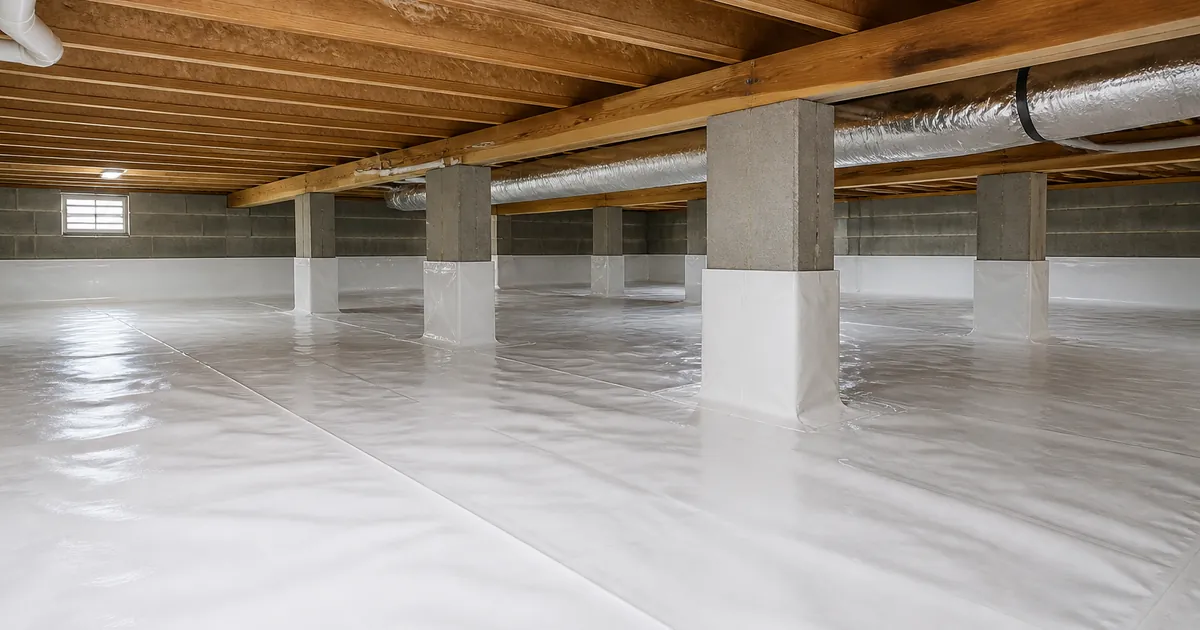
Crawl space vapor barrier costs depend on material quantity, product choice, and the work included. For Angier, NC, homeowners, a useful first step is checking units. Roll length, roll area, and installed coverage mean different things. A low roll price can hide a higher cost per square foot.
What affects crawl space vapor barrier costs?
Material cost starts with the product and amount being bought. Installed cost covers the agreed work as well. Length and area help explain the material portion, but neither describes the whole project. Keep the roll purchase, planned coverage, and full work price separate when reading a proposal.
A price needs a clear label to be useful. A roll price tells you the charge for one package. A square-foot rate tells you the charge against a stated area. A project total tells you the charge for a stated scope.
Those labels answer different questions. You might want to know which roll has a lower material rate. You might instead want to compare complete work at your home. Solving the first question does not solve the second.
This article uses one made-up material comparison to show the difference. Every dollar amount below is a hypothetical teaching input. None is a market price, company rate, offer, or home estimate.
The broader crawl space cost planning guide provides context for comparing work categories. Here, the main task is narrower: tracing what each number measures before using it.
Start with three separate cost ideas. Keeping them distinct prevents a simple unit error from shaping a large purchase.
- The package price states the cost of one defined roll.
- The material area rate divides that price by nominal roll area.
- The installed total covers the work named in the written proposal.
Why is roll length different from roll area?
Length measures one direction, while area measures a surface. A roll described as 100 feet long still needs a width. For a flat rectangular sheet, width times length gives nominal area. Two rolls can have equal lengths yet contain different amounts of material because their widths differ.
Area is measured in square units, as explained by NIST's guide to area. Feet describe length; square feet describe area. The word “square” changes what the number means.
Imagine a rectangular sheet that is 10 feet wide. If its length is 100 feet, its nominal area is 1,000 square feet. The calculation is 10 feet × 100 feet = 1,000 square feet.
Now imagine a sheet that is 12 feet wide. With the same 100-foot length, its nominal area is 1,200 square feet. The calculation is 12 feet × 100 feet = 1,200 square feet.
The second sheet contains 200 more nominal square feet. That follows from 1,200 minus 1,000. Both sheets remain 100 feet long, so comparing their lengths alone misses that difference.
A product label may describe width in a folded state. For this example, the stated widths mean full sheet widths. When reading a real listing, confirm what its width describes. A package dimension is not automatically a sheet dimension.
How do you compare a roll price with a square-foot rate?
Convert both prices to the same unit before ranking them. In this hypothetical example, Roll A costs $200 for 1,000 nominal square feet. Offer B costs $0.18 per nominal square foot. Comparing $200 with $0.18 directly says nothing useful because the charges buy different stated quantities.
Keep the earlier sheet sizes. Roll A is 10 feet wide and 100 feet long. Roll B is 12 feet wide and 100 feet long. Assume both offers cover material alone, with no tax, shipping, or other charges.
Assign Roll A a made-up price of $200 per roll. Assign B a made-up material rate of $0.18 per nominal square foot. For B, assume one whole 1,200-square-foot roll must be purchased. These assumptions define the exercise, not a real sale.
Normalize A by dividing its price by its nominal area. The calculation is $200 ÷ 1,000 square feet = $0.20 per square foot. B's stated rate is already $0.18 per square foot.
Convert B to a whole-roll price too. The calculation is 1,200 square feet × $0.18 per square foot = $216. B has the lower nominal area rate, while A has the lower whole-roll payment.
The difference in area rates is $0.02 per square foot. The difference in package payments is $16. Neither result tells you which package suits a property. They describe two distinct purchase measures.
| Measure | Roll A | Roll B |
|---|---|---|
| Full width × length | 10 ft × 100 ft | 12 ft × 100 ft |
| Nominal area | 1,000 sq ft | 1,200 sq ft |
| Whole-roll payment | $200 | $216 |
| Nominal area rate | $0.20 per sq ft | $0.18 per sq ft |
Can a price per linear foot reverse the comparison?
Yes, different widths can reverse a ranking based on length. In the same hypothetical example, A costs $2 per linear foot. B costs $2.16 per linear foot. A looks lower on that basis, yet B remains lower per nominal square foot because each foot of B is wider.
For A, divide the $200 roll payment by 100 feet. That gives $2 per linear foot. For B, divide $216 by 100 feet. That gives $2.16 per linear foot.
Each linear foot of A contains 10 nominal square feet. Each linear foot of B contains 12 nominal square feet. The length rates therefore refer to different amounts of surface material.
You can recover the area rates from these numbers. Divide A's $2 per linear foot by its 10-foot width. The result is $0.20 per square foot. Divide B's $2.16 by 12, giving $0.18 per square foot.
This is why an unlabeled “per foot” rate needs care. It could refer to length rather than area. Even a correctly stated length rate cannot fairly compare surface quantity without width.
Use the following sequence for a material listing. It checks the arithmetic without making a product choice.
- Read the price label and identify the quantity it buys.
- Confirm the full sheet width and length in matching units.
- Multiply width by length to calculate nominal rectangular roll area.
- Divide the material price by that area for a comparable rate.
- Keep the whole-roll payment visible beside the normalized material rate.
Why doesn't nominal roll area equal usable coverage?
Nominal area counts the sheet's full rectangular surface before any project layout. Usable coverage concerns where that material serves the planned work. The two figures describe different things. Our 1,000- and 1,200-square-foot roll areas do not establish how much crawl space either roll could cover after installation.
The example treats each sheet as a rectangle for arithmetic. It gives no crawl space shape, wall area, pier details, or material layout. Without those inputs, there is no basis for an installed coverage result.
Material assigned to one surface cannot count again as unique coverage elsewhere. Likewise, material lying over another piece does not create new ground area. That is a basic counting distinction, not a recommended seam design.
No overlap width or waste allowance is assumed here. Adding a standard-looking percentage would turn missing project details into an invented quantity. Dividing a home's listed size by roll area would have the same problem.
A leftover piece still has material area. Its value for a particular layout is a separate matter. A total area figure alone does not show which shapes fit the planned surfaces.
For coverage context, the existing vapor barrier quote guide discusses scope descriptions. It does not supply measurements for an Angier property. The roll math here should remain a material-unit comparison until a site-based plan defines coverage.
Which factors separate material cost from installed cost?
Installed cost includes the work described in the proposal, beyond the purchased sheet. Coverage, preparation, removal, access, and finishing details can make proposals differ. A material rate cannot price those tasks. It also cannot show if separate moisture work belongs in the project or falls outside it.
Picture two written proposals using the same liner material. One includes old-material removal, while the other excludes it. Their material rates may match, yet their totals buy different work. The difference is scope, not a unit conversion.
A similar issue arises with coverage. A ground-only area and a total including other surfaces have different boundaries. Dividing both totals by the same floor area would create tidy numbers without making the projects equal.
Moisture conditions deserve separate attention. NC State Extension includes crawl space moisture leaks, soil cover, sump operation, and exterior drainage in its mold and moisture checklist. Those checks provide general context, not findings about a particular home.
The EPA identifies moisture control as central to mold control in its home moisture and mold guide. A roll-area calculation cannot identify a moisture source or define work to address it.
Keep the cost categories distinct when reviewing a total. The existing vapor barrier scope discussion gives broader context for these boundaries.
- Material quantities describe purchased goods rather than all work hours.
- Preparation and removal belong in the comparison when the proposal includes them.
- Coverage boundaries show which surfaces the quoted work actually addresses.
- Separate moisture tasks need their own stated purpose and scope.
How should Angier homeowners use the final comparison?
Use the normalized rate to answer the narrow material question. Then use the written project scope to review the installed total. In our example, B is lower per nominal square foot. A requires a smaller whole-roll payment. Neither statement establishes the lower installed cost for an Angier home.
The math reaches a clear stopping point. A provides 1,000 nominal square feet for $200. B provides 1,200 nominal square feet for $216. Their normalized material rates are $0.20 and $0.18 per square foot.
There is no measured property in this exercise. There is no assumed roll count for a home. There is no finding that either product meets a design need. Those missing facts cannot be filled by choosing the smaller number.
For a real comparison, keep a small calculation note beside each offer. Record the unit, the area definition, and what the charge includes. This makes later changes easier to trace without rewriting the full proposal.
If one number includes installation and another covers material alone, area conversion still leaves a scope mismatch. Both rates might use square feet, yet the dollars pay for different things. Matching units is necessary, but matching inclusions matters too.
Angier's place name does not change these arithmetic rules. A useful local cost decision still needs property-specific quantities and work details. Start with sound units, preserve the scope differences, and avoid treating nominal material area as a finished project.
Questions about next steps? Call Carolina Encapsulation Company at 704-207-9348 or review encapsulation.
Frequently Asked Questions
Does a lower square-foot rate mean a lower checkout total?
No. In the hypothetical example, B has the lower nominal area rate. Its whole-roll payment is still $216, compared with A's $200. Package size explains the difference. If whole rolls must be bought, the amount paid depends on the package count and price, rather than the area rate alone.
Can I divide a roll price by its length alone?
Yes, but that gives a price per linear foot. It does not give a price per square foot. In the example, dividing A's $200 by 100 feet gives $2 per linear foot. To reach an area rate, its 10-foot width must enter the calculation as well.
Can equal nominal areas prove that two liners are equivalent?
No. Equal area means the sheets contain the same stated amount of surface material. It says nothing about their other product traits or fitness for a planned use. The worked example compares quantities and rates only. It does not rank thickness, strength, moisture performance, or suitability for a crawl space.
How should tax or delivery charges enter a material comparison?
Use the same charge boundary for both offers. The example excludes tax and delivery from each side. If actual offers treat those charges differently, keep the extra amounts visible. You can compare material-only rates separately from total purchase payments. Mixing one delivered total with another bare material price can distort the result.
Can I estimate roll needs from my home's listed square footage?
Listed home area does not define the planned liner surfaces or layout. Even a known ground area would not establish usable coverage from nominal roll area alone. Use a property-specific coverage plan for quantity decisions. The example's dimensions belong to imaginary sheets, not to an Angier home or a recommended purchase.
Sources
- SI Units Area, National Institute of Standards and Technology
- Mold and Moisture Checklist, NC State Extension
- A Brief Guide to Mold, Moisture and Your Home, U.S. EPA