Access door
The opening used to enter the crawl space. Its size, closure, condition, location, and surrounding grade affect usability, outside-air entry, pest resistance, equipment service, and emergency access. A sealed system still needs an access point that remains secure and practical.
Air sealing
The work used to limit uncontrolled air movement through vents, doors, penetrations, rim areas, and other openings. Air sealing should be coordinated with ground-vapor control, drainage, mechanical drying, combustion considerations, and any code requirements that apply.
Capillary action
The movement of liquid water through small pores or spaces in materials. Masonry and wood can draw moisture from wet soil or adjacent materials. Capillary movement is different from water vapor in air and should be considered when tracing damp walls or supports.
Condensate drain
The route that carries water removed from air by a dehumidifier or cooling equipment. It may rely on gravity or a condensate pump. The route, slope, trap, pump, outlet, and service access must match the equipment instructions and site conditions.
Condensation
Liquid water that forms when moist air contacts a surface cold enough for water vapor to change phase. Ducts, pipes, framing, and insulation can show condensation. The response should consider air conditions, surface temperature, water sources, insulation, and drying strategy.
Crawl space encapsulation
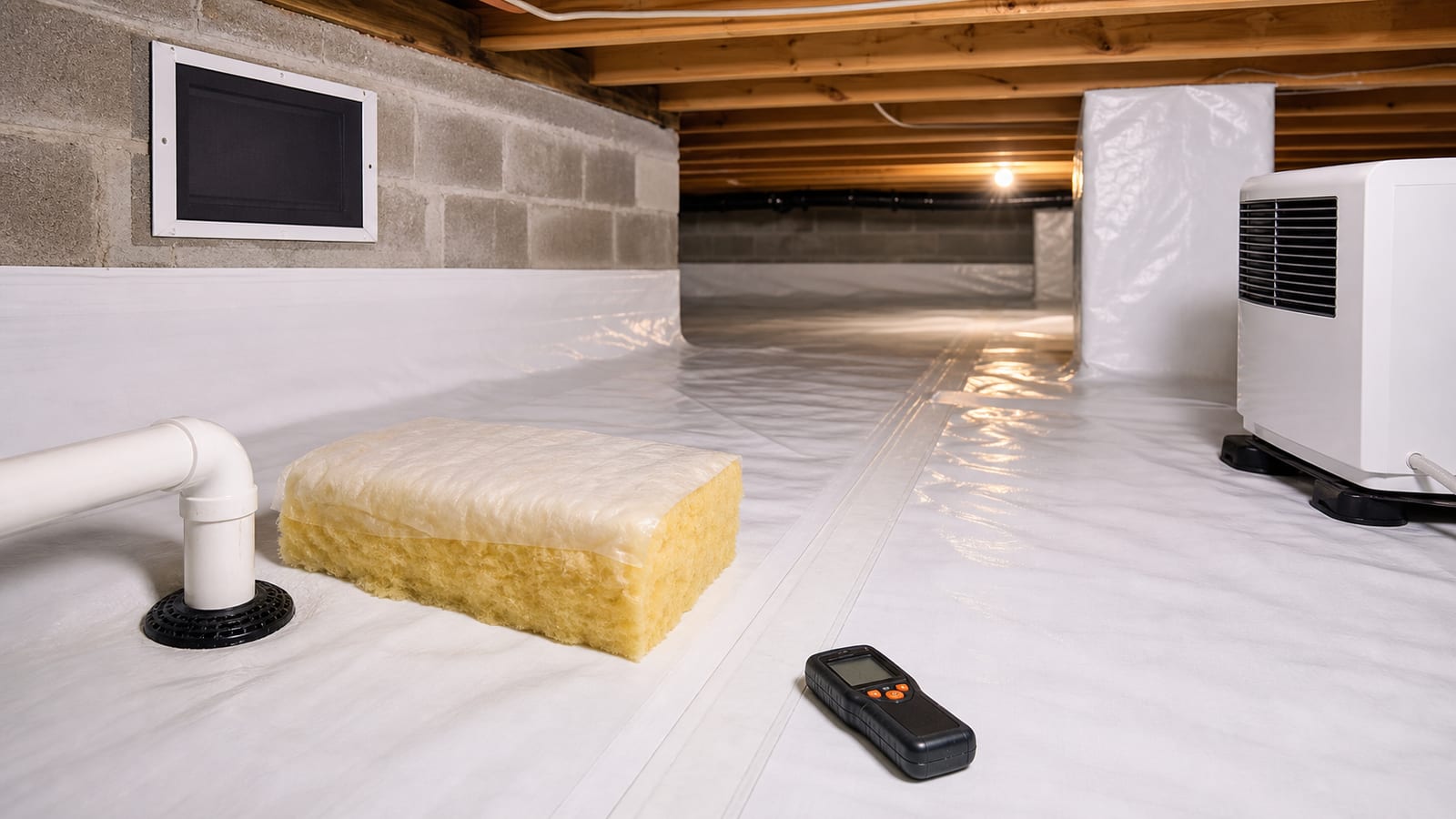
A coordinated system that limits ground vapor and uncontrolled outside-air exchange, then manages remaining moisture. Typical discussions include liner coverage, walls, piers, seams, vents, penetrations, drainage, dehumidification, access, monitoring, and future service.
Dehumidifier
Equipment that removes moisture from air and sends the collected water to a drain or pump. A dehumidifier manages airborne moisture within its operating conditions. It does not replace active water control, plumbing repair, ground coverage, or a complete system boundary.
Dew point
The temperature at which air with a given moisture content reaches saturation and condensation can begin. Dew point helps explain why humid outside air may create water on cooler crawl space surfaces even when no pipe or foundation leak is present.
Discharge point
The location where collected drainage or condensate leaves the system. A discharge point should be identifiable, serviceable, and appropriate for the site. It should not direct water back toward the foundation or create a new problem elsewhere.
Efflorescence
A mineral deposit that can remain on masonry after moisture moves through the material and evaporates. It is often white or light colored. Appearance alone should not be used for remote identification, but the deposit can prompt questions about the moisture path.
French drain
A drainage assembly that collects and conveys water through a trench, drainage medium, and pipe or channel. In a crawl space, the route, elevation, inlets, outlet or basin, sediment control, liner transition, and maintenance access all affect performance.
Ground vapor
Moisture that moves from soil into the crawl space environment as water vapor. It can be present without visible puddles. A continuous ground liner limits this transfer, while active liquid water and exterior runoff require their own evaluation.
Hygrometer
An instrument that reports relative humidity and sometimes temperature. One reading is a snapshot. Useful monitoring records the sensor location, date, weather, equipment status, and visible conditions so changes can be compared rather than interpreted in isolation.
Joist
A repeated horizontal framing member that supports the floor system above. Joists may show staining, notches, holes, splits, movement, decay, or pest evidence. Structural conclusions and repair design require the appropriate evidence and professional scope.
Liner seam
The joint where two pieces of crawl space liner overlap or connect. Seam design, preparation, fastening, and sealing affect continuity. A finished seam should remain observable enough to identify separation, damage, water above the liner, or changes after other work.
Moisture meter
A tool used to estimate moisture conditions in a material. Readings depend on the meter type, material, settings, temperature, location, contact, and comparison areas. One number should not be treated as a universal decay or structural-repair threshold.
Negative grade
Ground that slopes toward the foundation instead of away from it. The term describes a drainage condition, not a complete diagnosis. Roof runoff, soil, landscaping, hard surfaces, foundation details, and interior collection paths also belong in the review.
Pier
A masonry or concrete support beneath beams or other framing. Piers affect liner detailing, access, bearing, and inspection. Wrapping or sealing around a pier should not hide active water, movement, pest-access requirements, or structural conditions that need review.
Relative humidity
The amount of water vapor in air compared with the maximum the air can hold at that temperature, expressed as a percentage. Because temperature affects the percentage, trends and visible conditions are more useful than one isolated reading.
Rim area
The perimeter framing zone where the floor system meets the foundation. It can contain penetrations, gaps, insulation, and air-leakage paths. Work in this area should account for moisture, access, utilities, materials, and the complete crawl space design.
Sill plate
The wood member placed along the top of the foundation wall that supports or connects with the floor framing. Its proximity to masonry and exterior conditions makes moisture movement, pest evidence, access, and material condition important inspection considerations.
Sump basin
A container or pit that receives collected water before a sump pump discharges it. Basin placement, inlet elevation, volume, lid, float clearance, power, alarm, discharge, and service access should be coordinated with the complete drainage layout.
Sump pump
Powered equipment that lifts water from a basin to a discharge route. It only moves water that reaches the basin and depends on its power, controls, float, piping, outlet, and capacity. It does not stop every possible source of entry.
Subfloor
The structural panel or board layer above the floor joists and beneath the finished floor. From the crawl space, the underside may show stains, fasteners, repairs, openings, or moisture changes. A focused structural conclusion needs more than appearance alone.
Vapor barrier
A material used to limit water-vapor movement. In a crawl space, the term often refers to a ground liner, but thickness alone does not define coverage or a complete system. Seams, edges, walls, piers, penetrations, drainage, and durability also matter.
Vent well
A recessed area outside a foundation vent that creates clearance below the surrounding grade. Its height, drainage, cover, debris, and connection with the foundation affect whether exterior water can collect or enter near the opening.
Water table
The upper level of groundwater in the soil. Local conditions can change with rainfall, terrain, soil, drainage, and season. A wet crawl space does not prove a high water table, so the entry path and timing should be documented before choosing a response.
Wood decay
Deterioration of wood associated with organisms and moisture conditions. Color or softness alone is not a complete structural assessment. The moisture source, affected member, extent, connections, bearing, and remaining condition may require focused professional evaluation.
WDIR
A North Carolina Wood-Destroying Insect Information Report used in certain real-estate transactions. It reports visible evidence and defined related conditions within its scope, including limitations. It is not a complete moisture, structural, drainage, or encapsulation assessment.