Short answer
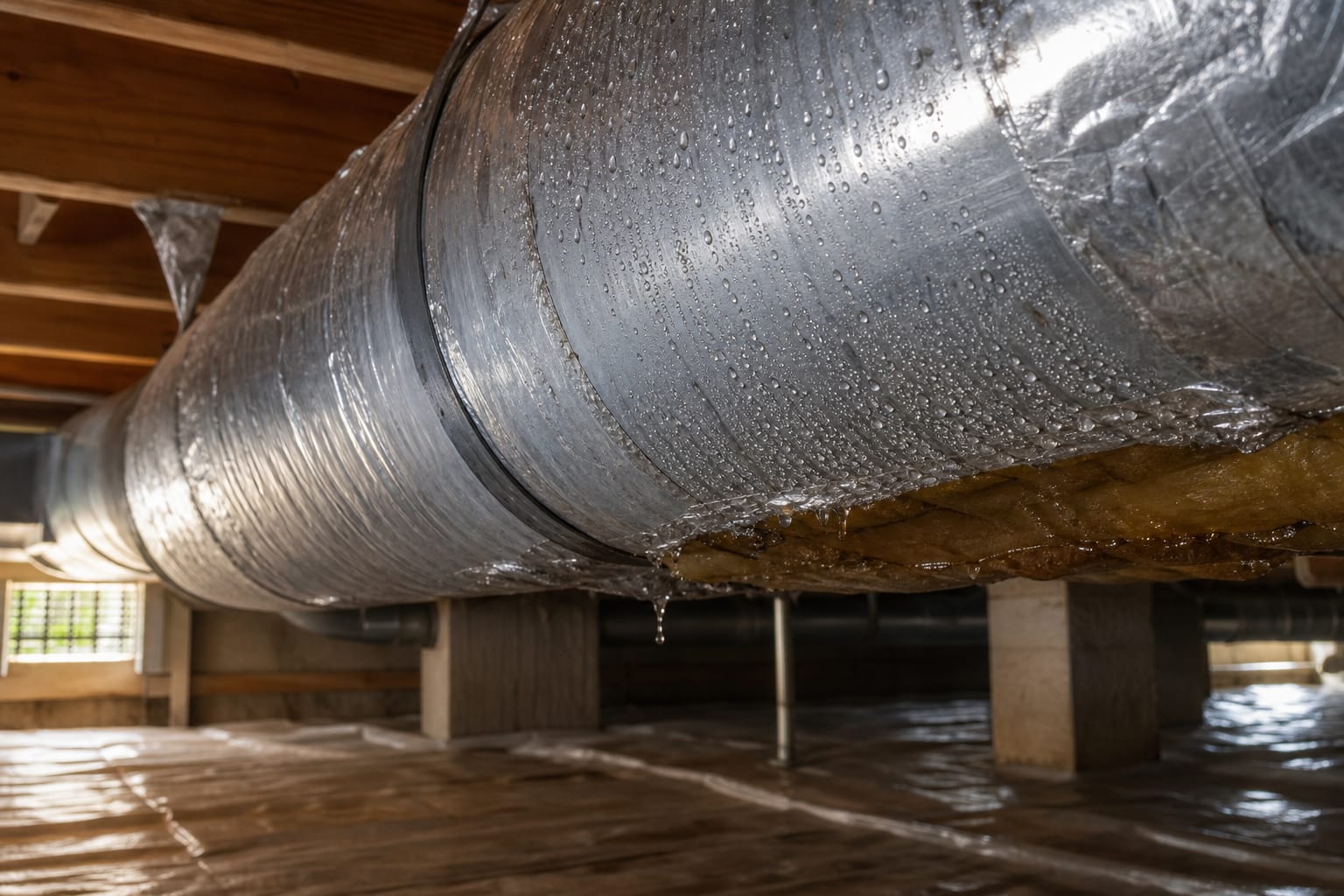
HVAC ducts sweat in a crawl space when a duct surface becomes colder than the dew point of the surrounding air. During a North Carolina summer, the crawl space can contain warm, moisture-laden air while the system carries much colder supply air. If humid air reaches a cold metal fitting, a poorly insulated section, or the outer jacket of insulation that is cold enough, water vapor condenses into droplets.
The droplets do not automatically mean the HVAC system is leaking water, and they do not identify one correction. Sweating can involve high crawl space moisture, humid outdoor-air entry, missing or compressed duct insulation, loose jacket seams, air leakage at a duct connection, or several conditions together. A plumbing leak and an AC condensate problem can also wet the same area, so trace the pattern before deciding.
The condensation and sweating-ducts problem page covers the broad issue. A useful summer inspection records which duct surfaces are wet, when droplets form, the nearby temperature and humidity, the insulation condition, and whether the water stops when cooling stops. Repeated wetting matters because it can soak insulation and nearby wood even when no standing water is visible.
Sweating is a dew-point event
Condensation depends on three things:
- the temperature of the surrounding air;
- the amount of water vapor in that air;
- the temperature of the surface.
Dew point connects those conditions. If the surface temperature falls below the air’s dew point, the air immediately beside the surface can no longer keep all its water vapor in gas form. Some vapor becomes liquid.
Supply ducts are common cold surfaces because they carry conditioned air. Bare metal collars, boots, takeoffs, and seams can become colder than the surrounding crawl space. Insulated ducts are intended to separate that cold surface from humid air, but insulation works only when it is continuous, dry, properly fitted, and protected by an intact vapor-retarding jacket.
Relative humidity is still useful, but it can be misleading by itself. A percentage measured at one location does not show the exact surface temperature of every duct. Temperature, dew point, location, and visual evidence belong together.
Why North Carolina summer conditions make ducts vulnerable
Warm-season air in the Triangle can carry substantial moisture. A vented crawl space or one with air leaks may receive that air through foundation vents, access doors, rim areas, utility penetrations, and gaps around framing. Damp soil can add another vapor source where ground coverage is incomplete.
At the same time, an air-conditioning system may run for long periods. The longer cold air moves through a duct, the longer exterior surfaces and fittings have to cool. A short mild-weather cycle might not create visible droplets, while an extended hot-afternoon cycle can.
Summer storms add variation. Rain can wet soil around the foundation, increase evaporation from exposed ground, or create active water entry. The crawl space may begin the day humid before the ducts cool. This is why “it only happens in July” or “it appears after afternoon storms” is useful history, not proof of a single cause.
Read the condensation pattern before touching anything
Do not open powered equipment, cut duct jackets, peel insulation, or touch wet wiring. Use a flashlight and photographs from stable, accessible positions.
Droplets spread along a long duct run
Uniform beads over a broad insulated surface can point toward high surrounding dew point, a cold outer jacket, wet insulation, or a jacket that is not controlling vapor as intended. Note whether the entire run is affected or only the underside.
Water concentrated at metal fittings
Collars, boots, plenums, hangers, and takeoffs can form thermal bridges where cold metal is closer to crawl space air. Condensation concentrated at these points can indicate missing insulation, gaps, compressed coverage, or air leakage that makes a fitting unusually cold.
One wet seam or connection
A localized wet seam may involve condensation, cold-air leakage, a loose connection, or water traveling from above. Look for the highest wet point and the shape of the stain. Water can run along a jacket and drip somewhere other than where it formed.
Wetness below plumbing or a drain line
Do not assume a duct caused water merely because it is nearby. Compare the location with supply lines, drain lines, bathroom fixtures, laundry, and HVAC condensate routing. Plumbing water may be warmer or appear independent of the cooling cycle. Do not taste, smell closely, or handle unknown water.
Wet insulation without visible surface beads
Insulation can become wet from a jacket puncture, leak above, earlier condensation, or water traveling along a duct. Sagging, staining, compressed areas, or a heavy-looking section deserves professional review. Opening the jacket may release fibers and destroy evidence.
Distinguish condensation from other water sources
Compare with the AC cycle
Record whether droplets form only while cooling runs, increase during a long cycle, and stop forming after the duct warms. Condensation often follows surface temperature. A plumbing leak may continue regardless of cooling operation.
Timing is useful but not conclusive because AC condensate equipment also follows cooling.
Find the top of the wet path
Water obeys gravity but can travel along framing, pipes, wires, duct jackets, and insulation. Start at the highest visible wet point and work downward visually. The puddle on the liner is the collection point, not necessarily the source.
Look at droplet distribution
Fine beads across a cold surface fit condensation more closely than one stream from a joint. A sharp water stain below one plumbing penetration suggests a different starting point.
Compare nearby materials
If only a cold duct surface is wet while nearby warm framing is dry, condensation is plausible. If walls, soil, framing, and insulation are all wet after rain, broader water entry or humidity may be involved.
Record weather and crawl space readings
Note outdoor conditions, recent rainfall, local crawl space temperature and RH, equipment status, and sensor placement. A dew-point calculation can help compare air conditions with a measured surface temperature, but consumer infrared tools have limitations on reflective metal and foil. Treat calculated values as supporting evidence.
Inspect the duct insulation as a complete layer
Duct insulation is not just thickness around a tube. It includes:
- insulation around the duct or fitting;
- an outer jacket or facing that limits vapor contact;
- sealed seams and transitions;
- proper support that avoids crushing;
- dry material;
- continuity at boots, collars, branches, and connections.
A small exposed metal area can collect more water than a broad insulated area. Crushed insulation beneath a strap may reduce thermal resistance. Torn outer jacket material can allow humid air to reach a colder layer. Wet insulation can perform differently from dry insulation and may stay wet after visible droplets disappear.
Do not wrap new material over a wet assembly without identifying why it became wet. Trapped water can remain hidden, and the original air leak or moisture source may continue.
The site’s crawl space insulation installation page describes insulation as part of a larger assembly rather than a surface patch.
Check air leakage on both sides of the problem
Humid crawl space air entering
Outdoor air may enter through vents, access gaps, open chases, and foundation penetrations. Air can also move from damp ground areas into the rest of the crawl space. Sealing decisions should account for the crawl space design, combustion safety, drainage, and humidity control.
The crawl space vent sealing and air sealing page provides planning context. Do not close openings at random as a same-day response to sweating ducts.
Cold conditioned air escaping
A loose duct joint can discharge cold air into the crawl space, chilling nearby surfaces and changing local air pressure. Clues can include a very cold spot, moving insulation, dust patterns, noise, or condensation centered on a connection. Proper testing may require HVAC tools and should not be replaced by feeling around wet energized equipment.
Air moving toward the house
Pressure differences can carry crawl space odor and moisture through floor openings and duct pathways. Sweating ducts are visible evidence of a cold-surface condition, but the broader air connection between crawl space and living area may also need evaluation.
Ground vapor and bulk water still matter
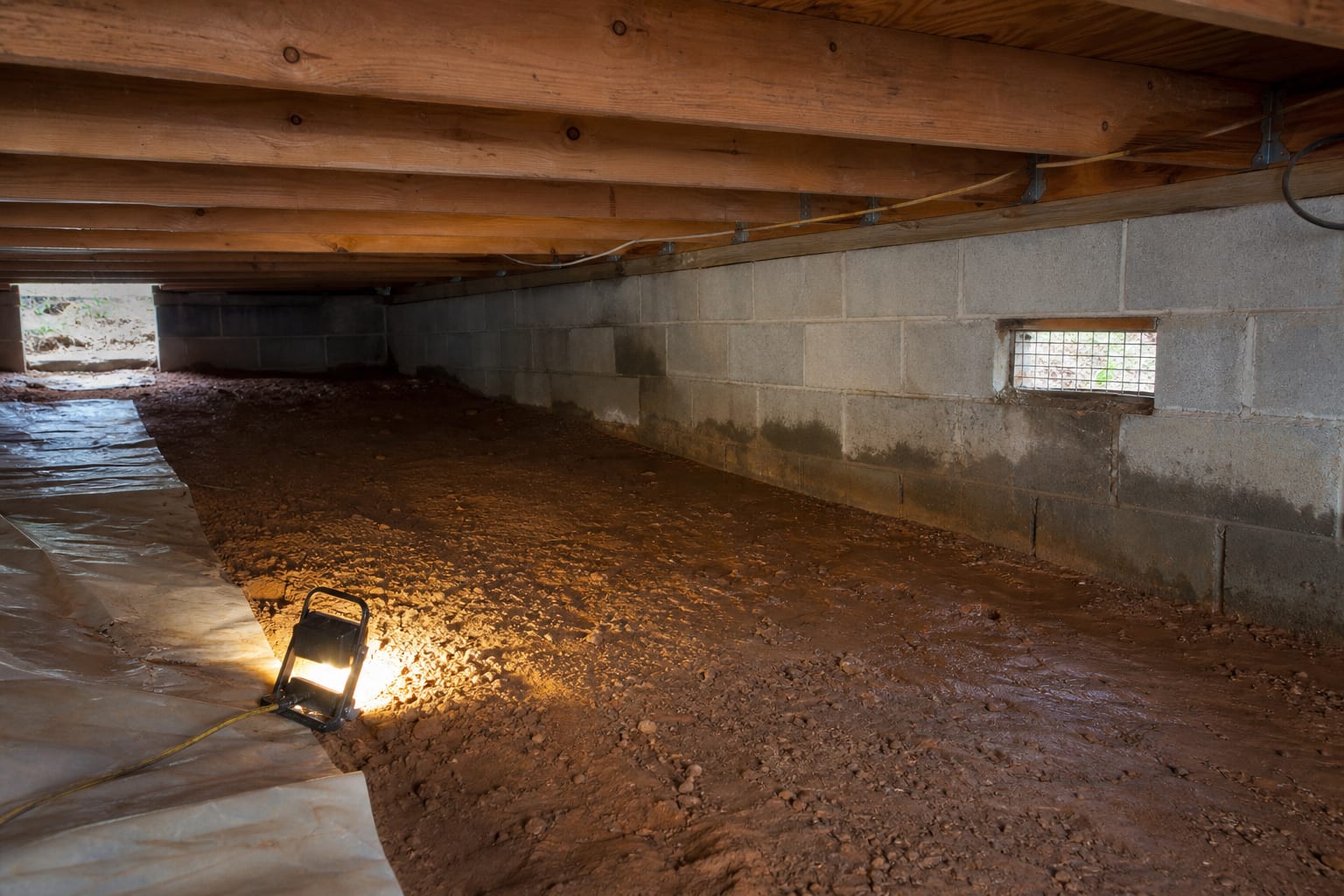
A duct problem cannot be evaluated in isolation from the ground and perimeter. Check whether the vapor barrier or encapsulation liner is continuous and dry on top. Look for open seams, pulled-back edges, exposed soil, punctures, and water trapped below the material.
Inspect foundation walls and low points after rain. Standing water, active seepage, saturated insulation, and wet framing can raise crawl space moisture beyond what duct insulation alone can address. The crawl space moisture-control service page explains the separate roles of bulk-water control, ground-vapor control, air management, and mechanical drying.
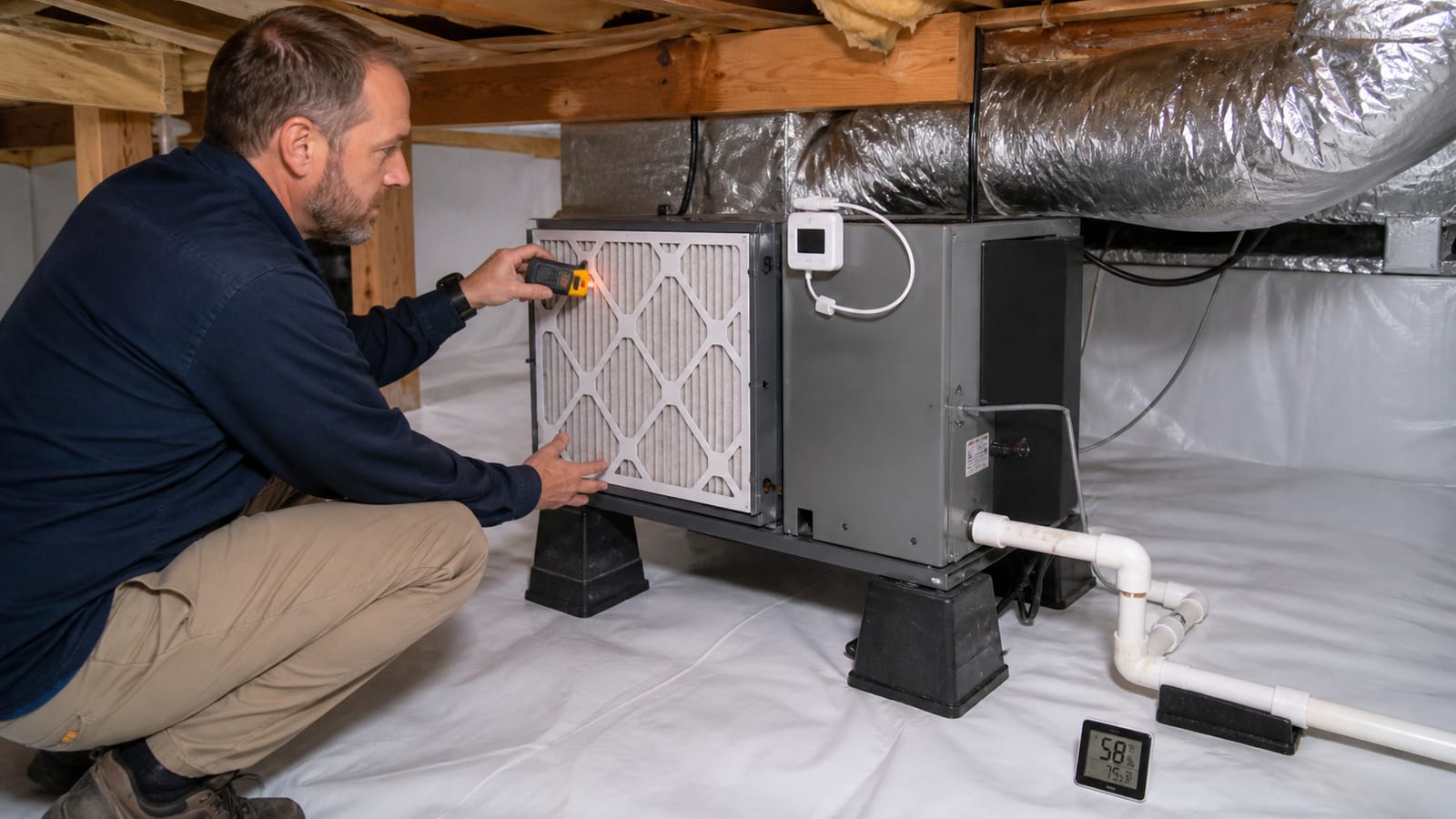
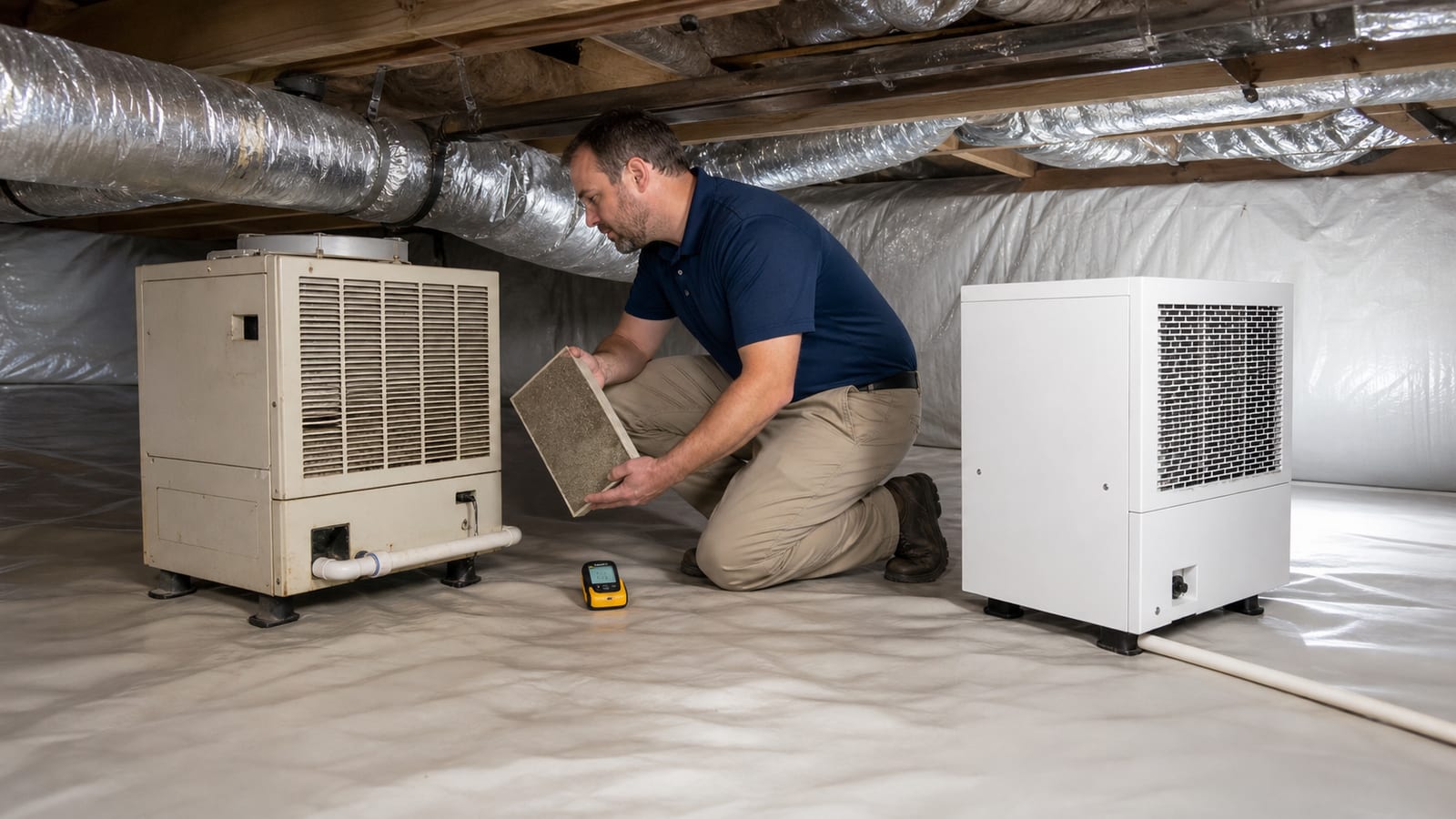
A dehumidifier can remove moisture from the air under appropriate conditions, but it cannot correct a plumbing leak, disconnected downspout, failed drain, or open duct connection. Source control comes first.
Why repeated droplets deserve attention
Even small beads can create a larger cumulative wetting pattern. Water can:
- soak the outer duct jacket or insulation;
- drip onto fiberglass between floor joists;
- wet wood framing or subfloor;
- collect on a liner and resemble foundation seepage;
- corrode unprotected metal;
- carry dust and leave misleading stains;
- keep a localized area damp after the AC cycle ends.
This does not establish structural damage or biological growth. It does explain why recurring condensation should be documented and traced rather than accepted as harmless summer “sweat.”
Avoid claims based on appearance. Dark marks can be dirt, rust, adhesive, water staining, or suspected growth. Moisture evidence and appropriate inspection come before material identification.
A practical documentation checklist
Record the condition without altering it:
- Date, time, and recent rainfall.
- Outdoor temperature and dew-point information, if available.
- Crawl space temperature and RH at a labeled location.
- Whether the AC is actively cooling.
- Which duct run, branch, fitting, or boot is wet.
- The highest visible wet point.
- Whether droplets are fine beads, a stream, a stain, or wet insulation.
- Nearby plumbing, drains, and equipment.
- Condition of visible duct jacket seams and supports.
- Ground liner, foundation wall, and low-point conditions below.
- Photographs before, during, and after a cooling cycle.
- Whether the same location dries fully between events.
Use a simple floor sketch if several duct runs look similar. Label directions and nearby rooms rather than relying on a close-up photograph that cannot be located later.
Corrections depend on the source combination
An inspection may find one or several needs:
- repair and seal a duct connection;
- restore continuous, dry duct insulation and jacket coverage;
- correct humid air entry as part of a closed-crawl-space plan;
- improve ground-vapor coverage;
- manage exterior or interior bulk water;
- service humidity-control or drainage equipment;
- remove and replace material that cannot be dried or restored appropriately.
The order matters. Replacing wet duct insulation before stopping active water or humid-air contact can recreate the condition. Installing a dehumidifier while a drain is blocked can add another maintenance problem. A crawl space dehumidifier assessment should follow, not replace, water and air-path review.
Limitations and when to arrange an inspection
Arrange a crawl space and HVAC review when:
- ducts repeatedly bead or drip during cooling;
- insulation is wet, compressed, torn, or sagging;
- water is near wiring, motors, outlets, or controls;
- one connection is unusually cold or noisy;
- stains or wet framing are spreading;
- humidity stays elevated across more than one location;
- water appears even when the AC is off;
- the source could be plumbing or condensate equipment;
- an access or crawl route is unsafe;
- the same repair area has become wet again.
An HVAC professional may need to evaluate duct connections, insulation, air leakage, and equipment condensate. A crawl space inspection may need to evaluate water, vapor, drainage, access, and humidity. Coordinating the evidence prevents each system from being treated as if it exists alone.
Frequently asked questions
Is a small amount of duct condensation normal in summer?
Visible condensation means the surface is below the surrounding air’s dew point. A one-time trace and repeated dripping are different in scale, but neither should be diagnosed from a photograph alone. Record where and when it forms, then check insulation, humidity, air leakage, and other water sources.
Can I wipe the ducts dry and monitor them?
Only if the area is safely accessible and there is no electrical or material hazard. Wiping removes current droplets but not the cause. Photograph the condition first, avoid damaging the jacket, and confirm whether water returns during a comparable cooling cycle.
Will adding more duct insulation stop sweating?
It may help when the existing thermal and vapor-control layer is incomplete, but adding material over wet insulation or an unsealed connection can hide the source. The existing assembly, air leakage, crawl space dew point, and water conditions should be evaluated first.
Why is only one metal collar wet?
That collar may be more exposed, less insulated, colder because of air leakage, or located in a more humid pocket. Water from above can also travel to it. Inspect the surrounding jacket, connection, plumbing, and highest wet point before assuming the collar itself is defective.
Does sweating ductwork mean the crawl space needs encapsulation?
Not by itself. Condensation confirms a relationship between moisture and surface temperature. The appropriate response depends on exterior water, ground vapor, ventilation, air leakage, duct condition, drainage, and equipment. Encapsulation is one system approach, not a conclusion based on one wet duct.
Sources and further reading
- National Weather Service: Why Dew Point Is a Better Measure of Humidity
- NC State Extension: Mold and Moisture Checklist
- U.S. Department of Energy: Unvented, Conditioned Crawlspaces
- U.S. EPA: Mold Course, Chapter 2, Moisture Basics
How this applies in Garner, NC
For homeowners in Garner, NC, this question is most useful when the record includes the recent weather, the first place the condition appeared, and whether cooling equipment was operating. The Triangle is warm and humid for much of the year, but that regional context does not identify the moisture source at one property. Compare the condensation sweating ducts with the How to Read a Crawl Space Hygrometer Without Chasing Every Number in Apex, NC before choosing a property-specific next step.