Short answer
A gravity drain is usually the simpler option when condensate can travel continuously downhill through protected tubing to a suitable outlet. A condensate pump is useful when the dehumidifier sits below the available discharge point or the route cannot maintain fall. The pump solves an elevation problem, but it adds power, a reservoir, a float, an outlet tube, and maintenance points. The better choice depends on measured elevations, the complete route, outlet conditions, equipment instructions, and how a failure would be noticed.
Both options have the same job
A crawl space dehumidifier pulls water vapor from the air and turns it into liquid condensate. That water has to leave the space reliably. If it remains in a pan, leaks onto the liner, or discharges beside the foundation only to return, the moisture-control system is working against itself.
The drain decision is therefore part of crawl space dehumidifier installation, not an accessory to think about after the unit is set in place. Equipment location, service access, electrical supply, the crawl space grade, wall penetrations, freeze exposure, and the final discharge point all affect the route.
Neither method is universally better. Gravity has fewer powered components, but it cannot lift water and will not overcome a low spot. A pump can lift condensate, but it needs electricity and periodic inspection. A short route can still fail if it is kinked or unprotected. A long route can work if it is properly supported and remains open from inlet to outlet.
How a gravity drain works
A gravity drain relies on elevation. The dehumidifier outlet must be higher than every downstream section that needs to carry water, and the tube or pipe must maintain fall toward the outlet. Water moves without a separate pump because the route never asks it to climb.
That sounds simple, but the whole path matters. A tube can begin downhill and then rise over a pier, sag between supports, or turn upward before exiting. Each low point can hold water and debris. Each high point can stop flow if the available head is insufficient. An installer needs to verify the route rather than judging only the first few feet.
Conditions that support a gravity drain
A gravity route is a practical candidate when:
- The equipment outlet is measurably above the discharge point.
- Continuous fall can be maintained around piers and other obstructions.
- The line can be supported so it does not sag or become crushed.
- The outlet is accessible for inspection and does not send water back toward the foundation.
- The route can be protected from animals, trade traffic, sharp liner edges, and stored items.
- The equipment instructions allow the proposed connection and tubing arrangement.
The word “continuous” is important. A loop resting on the liner may become a trap. A tube tucked under insulation may be hard to inspect. A line that exits through a wall but ends in an eroded depression can move water out of the crawl space while creating a new exterior problem.
Advantages of gravity
Gravity drainage does not depend on a second motor, float, reservoir, or electrical connection. That means fewer components can fail. It can also continue carrying condensate during an electrical outage once water is in the line, although the dehumidifier itself will not produce new condensate while it has no power.
The route is often easier to understand visually. A homeowner can follow the line from the unit to the outlet and check for a sag, disconnection, pinch, or blocked termination. Simplicity is valuable only when the elevations genuinely support it.
Limits of gravity
Gravity cannot move water uphill. Raising the dehumidifier may create fall, but equipment still needs a stable platform, clearance, service access, and a location consistent with its instructions. Placing a unit precariously on blocks to gain elevation is not a sound drain design.
A gravity line also remains vulnerable to:
- Sediment or biological buildup in a low-flow tube
- Kinks where flexible tubing turns
- Compression under insulation, stored items, or trade traffic
- Sagging between widely spaced supports
- Insects or debris at an exposed outlet
- Freezing at an exterior segment
- Settlement that changes the original slope
These are inspection concerns, not proof that a pump is required.
How a condensate pump works
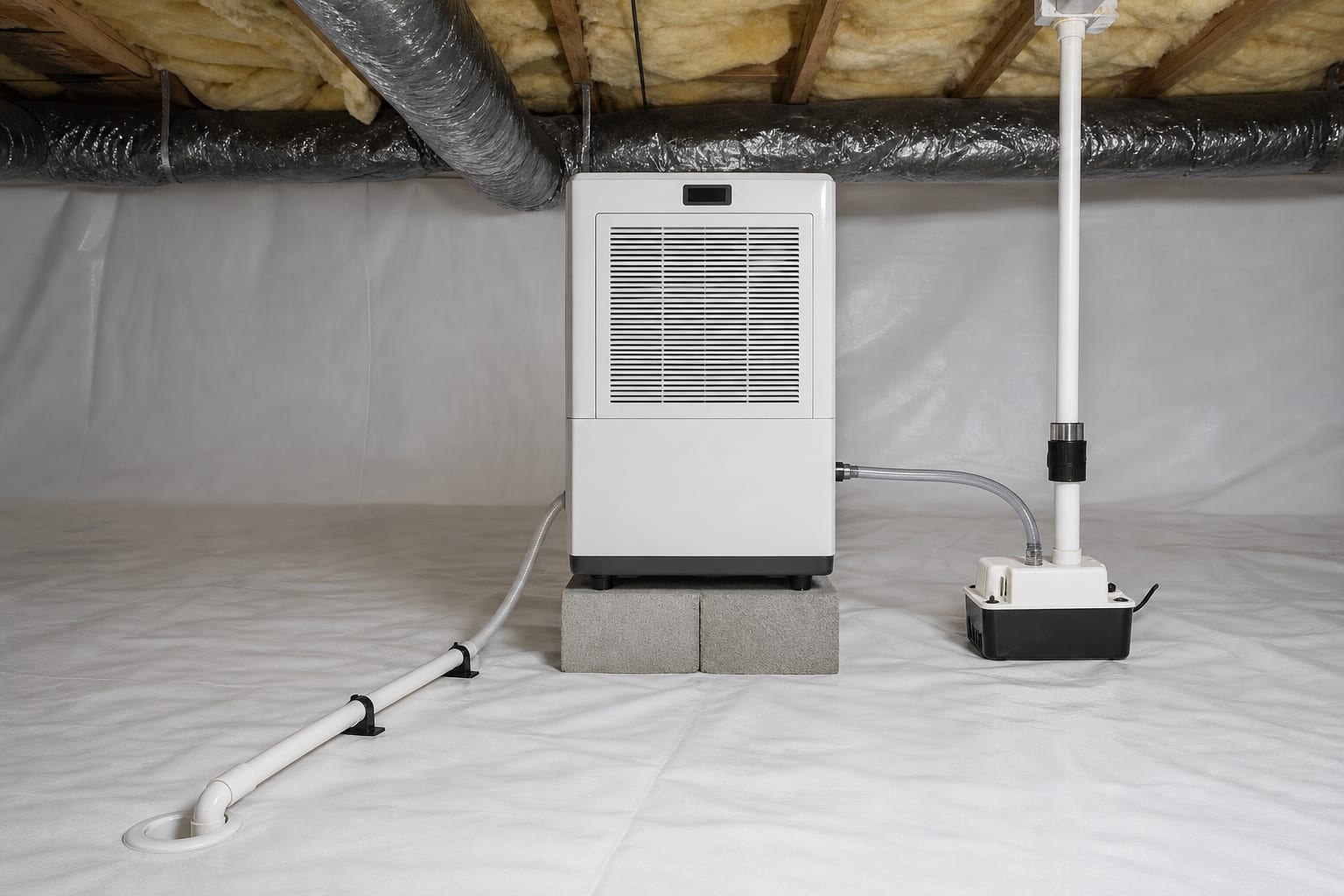
A condensate pump collects water in a small reservoir. As the level rises, a float or sensor activates a pump that pushes water through a discharge tube. Because the pump supplies pressure, the line can rise before traveling to the outlet, within the equipment’s specified limits.
This arrangement is useful when the crawl space is lower than every practical outlet, the dehumidifier must remain in a low central area, or obstacles make a continuously descending route unrealistic.
Conditions that support a pump
A pump may be appropriate when:
- No suitable gravity outlet sits below the dehumidifier drain.
- The planned route must rise to pass through the foundation or reach another approved connection.
- The crawl space geometry creates unavoidable low points.
- The pump can sit level, remain accessible, and be protected from damage.
- A proper power source is available.
- The discharge route and lift remain within the pump instructions.
- The system includes a clear way to detect a failure or high-water condition.
The pump should not be selected only because it makes routing faster. Its reservoir, float, check valve if present, tubing, power, and final outlet all become part of routine dehumidifier maintenance.
Advantages of a condensate pump
The main advantage is lift. A pump can move condensate to a higher wall penetration or across a route where gravity cannot be maintained. It can give the dehumidifier a better service location rather than forcing the cabinet onto an awkward platform.
Some systems can also provide an alarm contact or equipment shutoff when the reservoir remains high. Whether those features exist and how they are wired must be confirmed from the actual equipment documentation. Do not assume an alarm is present because a pump is visible.
Limits of a pump
A condensate pump depends on power. It also has moving and sensing parts that can foul, stick, disconnect, or wear. A blocked discharge can make the reservoir fill even when the motor runs. A loose tube can let the pump send water onto the liner.
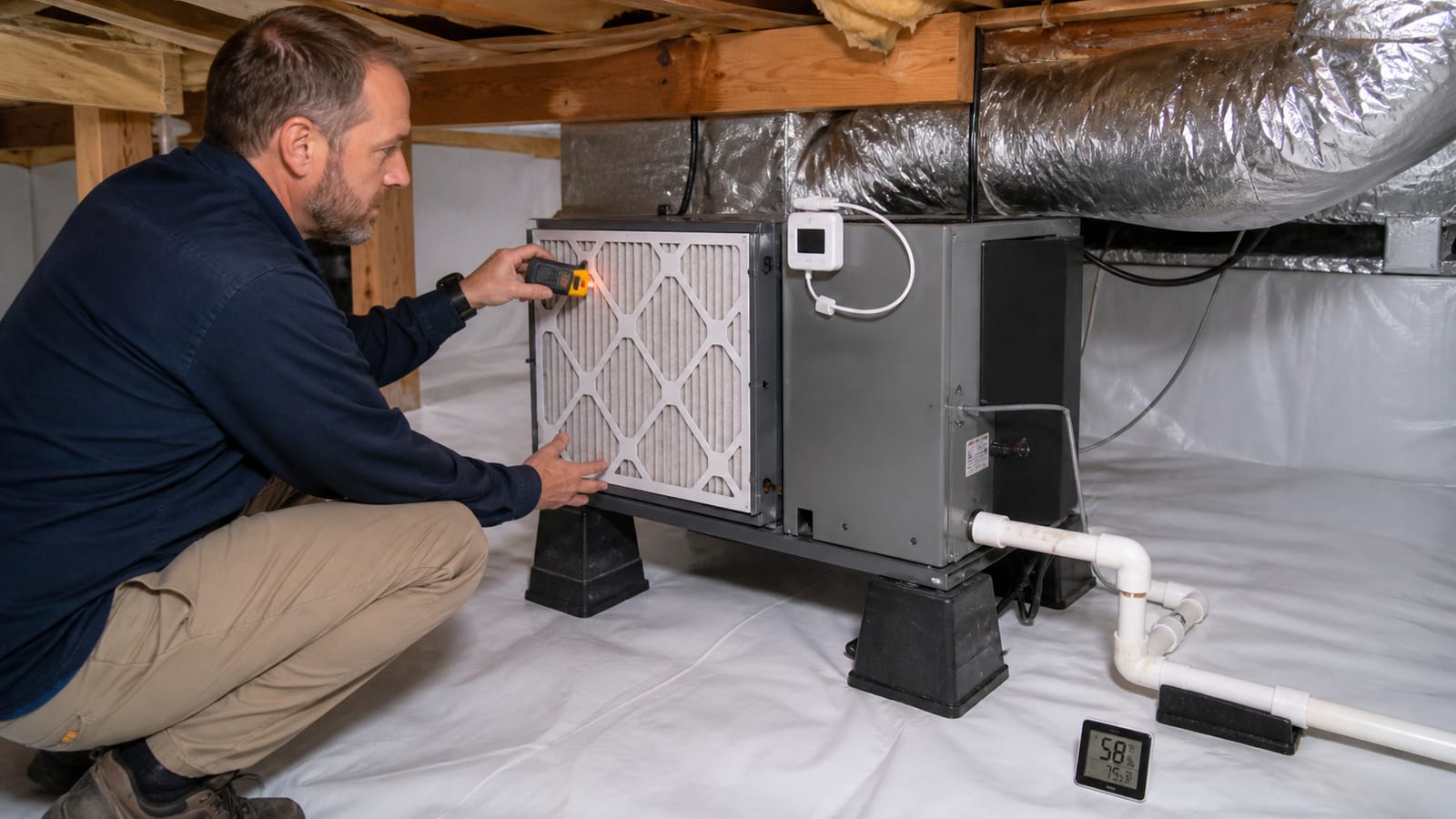
Common inspection points include:
- Power supply and plug condition
- Reservoir cleanliness
- Float or sensor movement
- Inlet alignment from the dehumidifier
- Discharge-tube attachment
- Check-valve condition where the design uses one
- Kinks, abrasion, or pinches along the tube
- Evidence of overflow or repeated wetting
- The condition of the final outlet
Opening electrical compartments or bypassing a float is not a homeowner check. Service should follow the pump and dehumidifier instructions.
Gravity drain and condensate pump compared
| Question | Gravity drain | Condensate pump |
|---|---|---|
| What moves the water? | Elevation and continuous fall | A powered pump |
| Can the route rise? | No | Yes, within equipment limits |
| Does it need separate power? | No | Yes |
| Main vulnerability | Sag, low spot, kink, blocked outlet | Power, float, reservoir, motor, tubing, blocked outlet |
| Routine visibility | Follow line and inspect outlet | Inspect reservoir, operation, line, and outlet |
| Outage behavior | Drain remains passive, but dehumidifier stops | Pump and dehumidifier stop unless a verified backup arrangement exists |
| Best use | A protected downhill route to a suitable discharge | A route that must lift condensate |
This table compares mechanisms. It does not establish which discharge location is acceptable for a particular home.
The discharge point matters as much as the method
Moving water out of the crawl space is only half the job. The outlet should not create ponding beside the foundation, wet a walkway, erode soil, drain into an inappropriate connection, or become buried by landscaping. Local requirements and site conditions can affect what is acceptable.
Trace the complete route:
- Identify the dehumidifier drain outlet.
- Follow the line to any trap, pump, wall penetration, or connection.
- Confirm whether the line falls, rises, or sags.
- Locate the final visible discharge.
- Observe the area after operation or rainfall.
- Check whether water moves away or returns toward the foundation.
The foundation drainage improvements page addresses the broader exterior water path. A condensate line produces far less flow than a roof downspout, but its location still matters because it may discharge repeatedly during humid weather.
Questions to answer before choosing
What does the equipment manual require?
The dehumidifier documentation controls outlet connections, trap needs, tube size, lift limits, clearance, and service procedures. The condensate-pump documentation controls reservoir setup, maximum lift, check-valve use, alarms, and cleaning. A general article cannot replace those instructions.
Is there a real elevation survey?
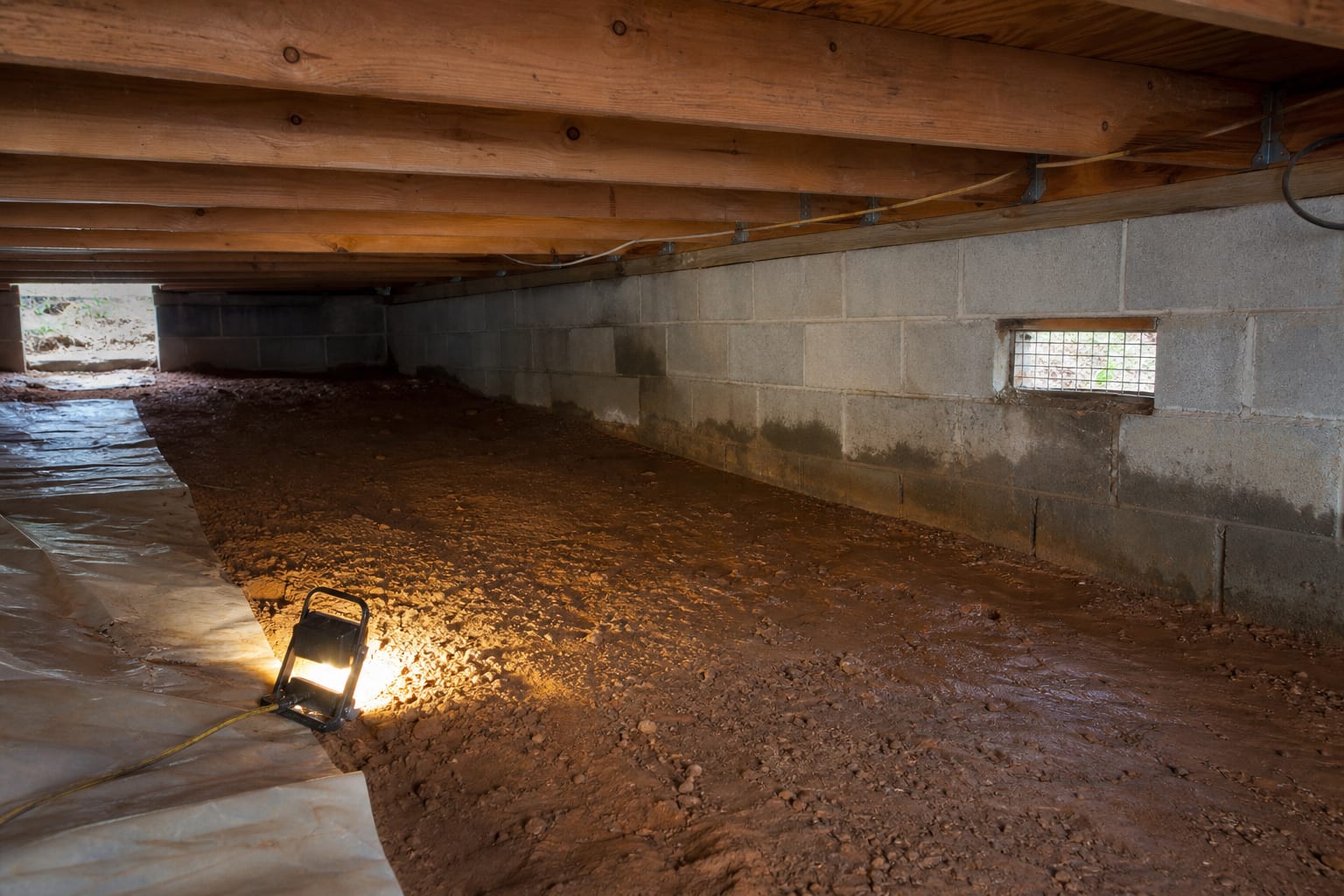
“It looks downhill” is not enough for a route that crosses a long, uneven crawl space. Check the equipment outlet, foundation penetration, intermediate supports, and final discharge. The lowest visible soil area is not automatically the best unit location.
Can the route be inspected later?
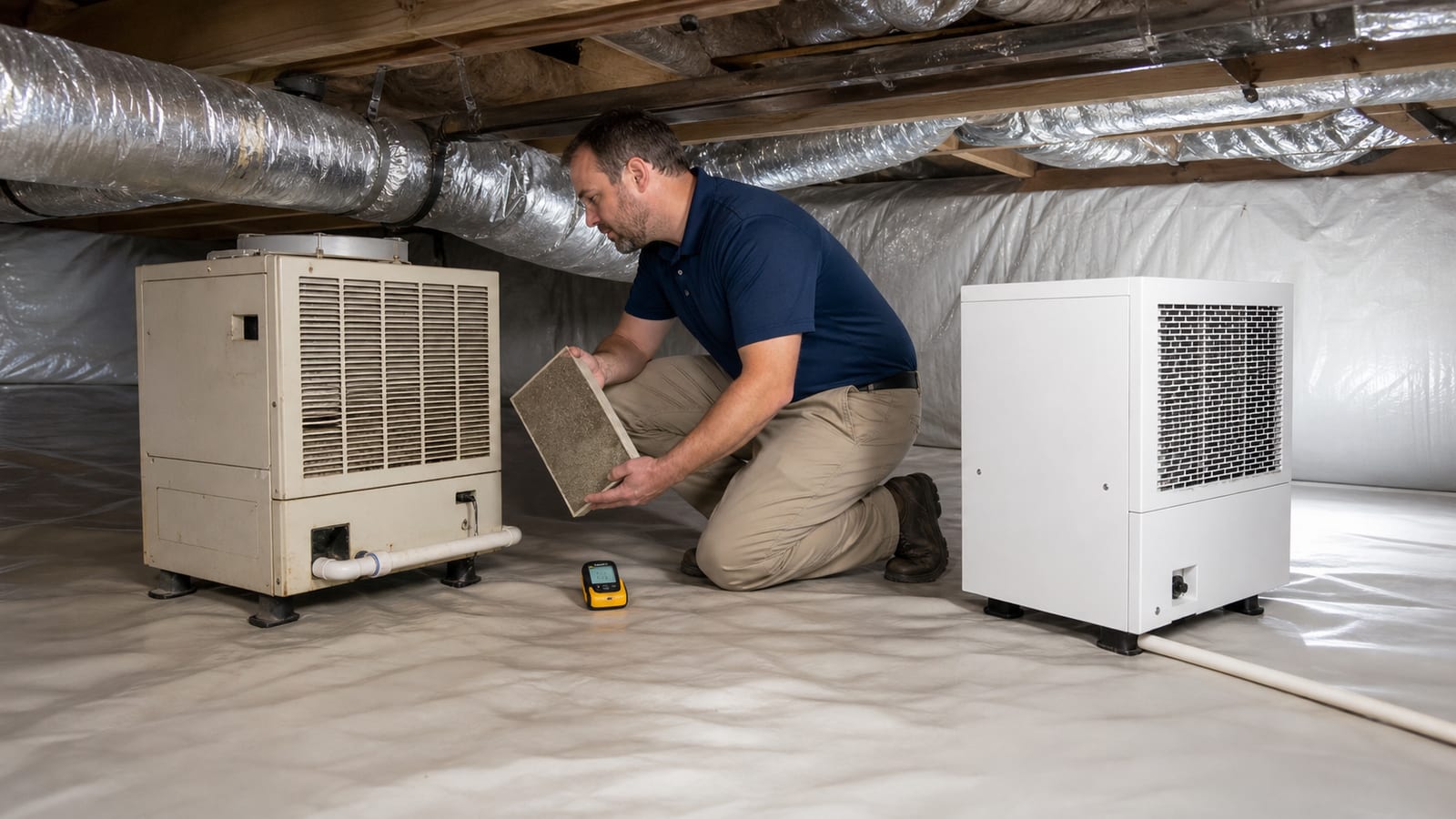
A drain hidden behind permanently sealed material or buried without access is difficult to troubleshoot. Plan for filter changes, drain flushing if the manual calls for it, pump cleaning, outlet observation, and removal of the unit for service.
What happens when a component stops?
For gravity, consider what happens if the line clogs or freezes. For a pump, consider a power outage, stuck float, blocked discharge, or disconnected tube. Is there a high-water alarm? Does the dehumidifier stop, or can it keep adding water to a full reservoir? The answers depend on the actual components and wiring.
Will other work disturb the line?
Plumbers, HVAC technicians, pest professionals, and inspectors may cross the crawl space. A tube laid loose across an access path is easy to crush or pull. Use protected routing and clear documentation so later work does not unknowingly disable the drain.
Maintenance should prove that water reaches the outlet
Looking at the dehumidifier display does not prove that condensate is leaving. Periodic checks should include the inlet, route, and outlet. The exact interval comes from the equipment manuals and site conditions, especially dust, pest activity, seasonal use, and prior clogs.
A practical record includes:
- Date and crawl space humidity
- Filter condition
- Water around the cabinet or pump
- Visible tubing condition
- Pump alarm or status if present
- Confirmation that discharge reached the intended outlet
- Changes to landscaping, grade, or access
If the space develops high crawl space humidity, do not assume the drain is the only cause. Air leakage, unit capacity, dirty airflow components, open access, new water entry, or sensor placement may also affect conditions.
Limitations and when to schedule an inspection
A homeowner can follow visible tubing, note equipment status, observe the outlet, and record humidity. Do not open electrical components, defeat an alarm, splice wiring, enter standing water, or disconnect a line while the equipment is operating.
Schedule an inspection when water appears around the unit, the reservoir repeatedly fills, the pump cycles without discharging, the gravity line contains standing water, the outlet cannot be found, humidity rises persistently, or the proposed route requires uncertain connections. An inspection can compare elevations, verify the full discharge path, and keep the drain choice connected to the complete moisture-control plan.
Frequently asked questions
Is a gravity drain more reliable than a condensate pump?
It has fewer powered components, but reliability still depends on continuous fall, support, protection, and an open outlet. A poorly routed gravity line can fail just as a neglected pump can.
Can a condensate pump move water uphill?
Yes. Lift is its main purpose. The allowed vertical rise, total route, tube size, and connection must follow the specific pump instructions.
Can dehumidifier condensate drain onto the crawl space liner?
It should not be treated as a normal discharge plan. Water left on the liner remains in the space and may reach seams, low areas, equipment, or materials. The drain should lead to a verified outlet.
Will a condensate pump work during a power outage?
Not unless it is connected to a verified backup arrangement designed for that load. The dehumidifier also stops without power, but water already in the reservoir may remain until power returns.
Can I switch from a pump to gravity drainage?
Possibly, if the equipment outlet can be placed above a suitable discharge and the entire route maintains fall. Elevations, access, outlet conditions, and equipment instructions should be checked before changing the system.
Sources and further reading
- U.S. Department of Energy: Standard Work Specifications for Single-Family Home Energy Upgrades
- U.S. Department of Energy: Unvented Conditioned Crawlspaces
- U.S. Environmental Protection Agency: A Brief Guide to Mold, Moisture and Your Home
- North Carolina State Extension: Mold and Moisture Checklist
How this applies in Willow Spring, NC
For a home in Willow Spring, NC, keep this observation with the maintenance record for the actual liner, access, drain, sump, and dehumidification equipment in place. A location-specific record helps an inspection start with what changed instead of treating every encapsulated crawl space as the same system. Compare the crawl space dehumidifier installation with the How to Read a Crawl Space Hygrometer Without Chasing Every Number in Apex, NC before choosing a property-specific next step.