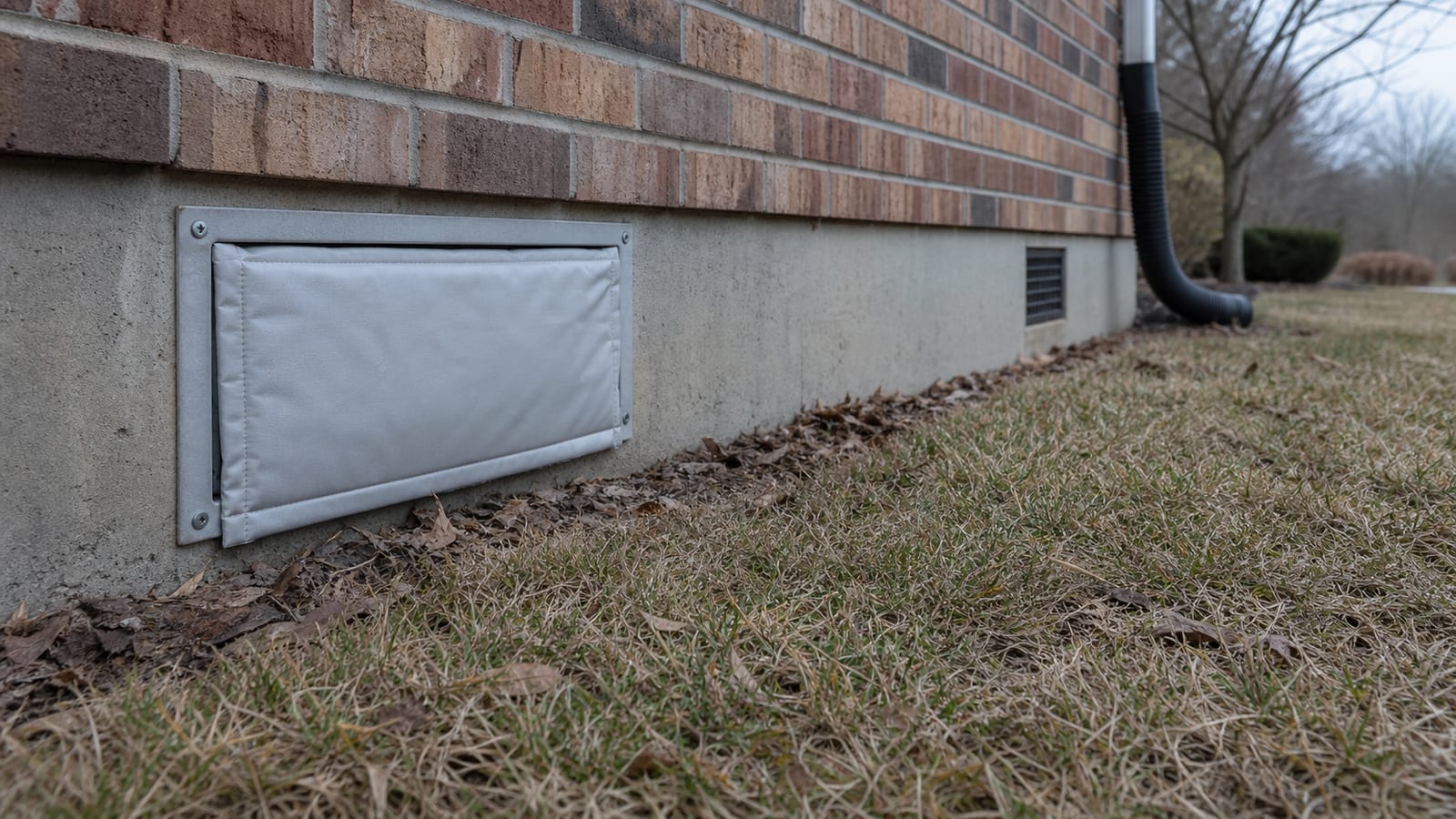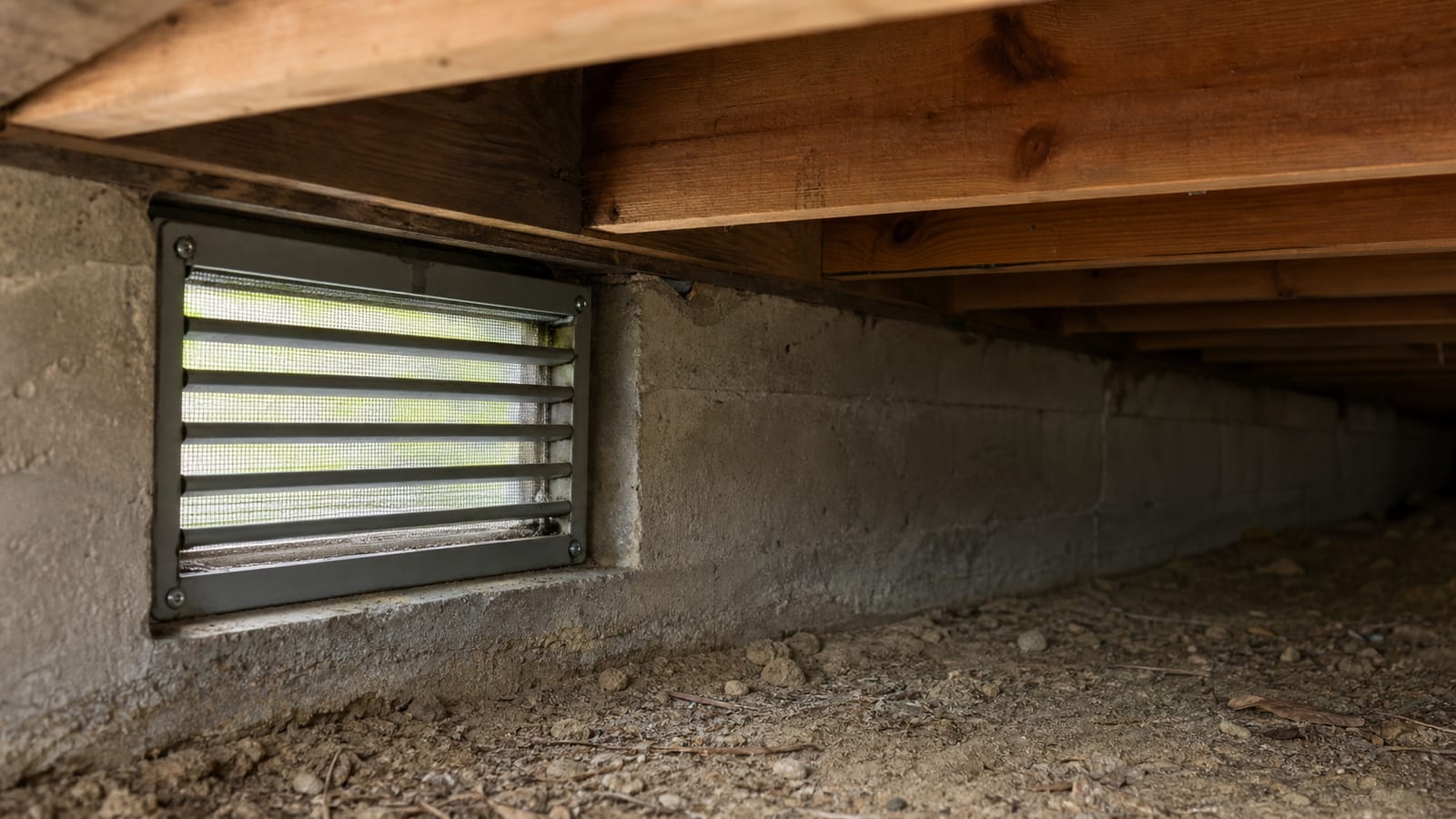
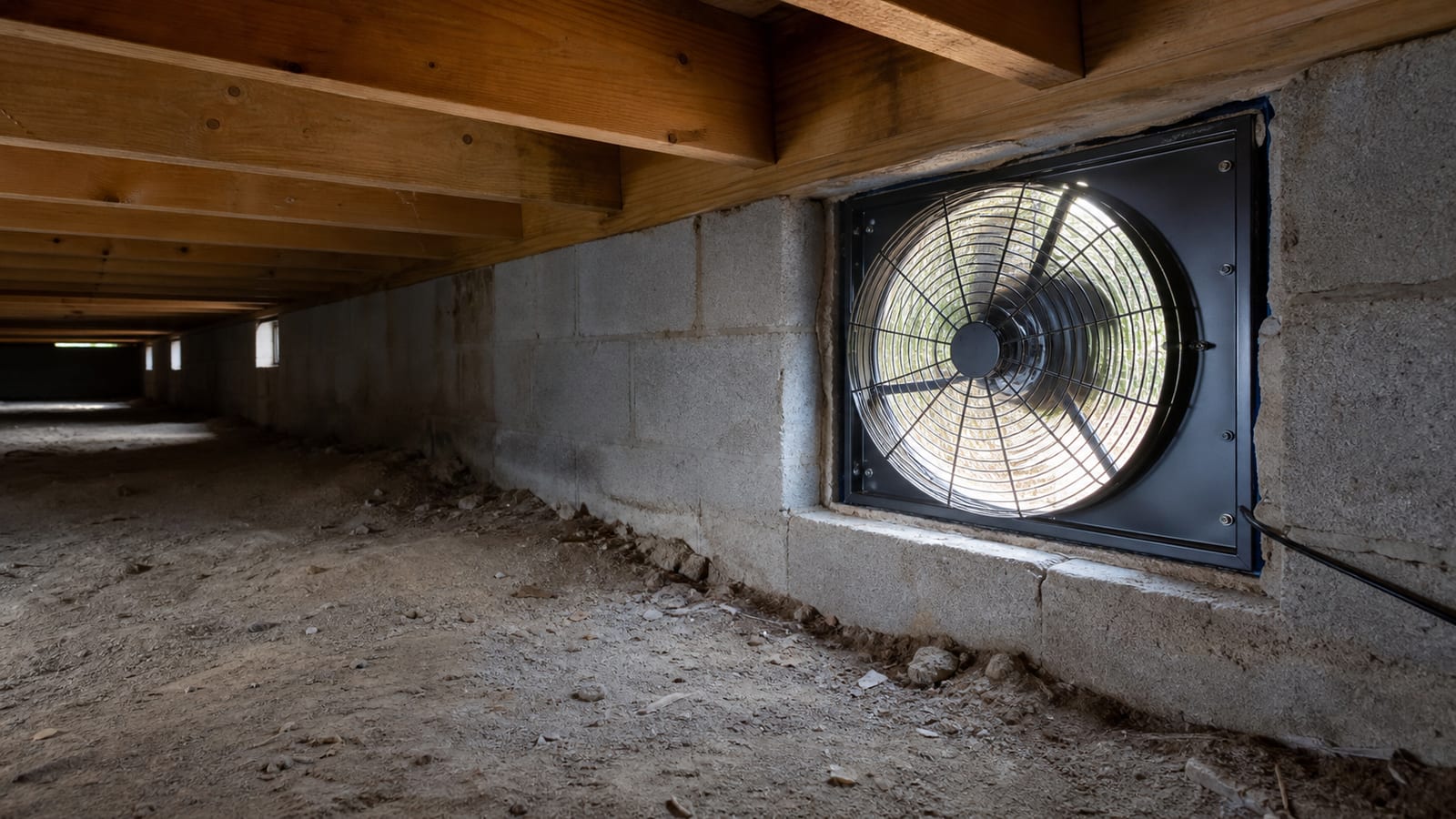
Crawl space ventilation fans can move air, but they do not automatically solve humidity. Their result depends on where replacement air comes from, how much moisture that air contains, and whether ground vapor or liquid water is still entering. A fan can support a defined design, yet it can also increase moisture during humid weather.
This distinction matters in North Carolina, where warm outdoor air may carry considerable water vapor. Exhausting crawl-space air creates pressure that pulls replacement air through vents, access gaps, soil openings, floor penetrations, or the home. Before adding a fan, identify those paths and measure conditions instead of assuming that more movement means more drying.
How does a crawl space ventilation fan affect humidity?
A crawl space ventilation fan affects humidity by replacing or redistributing air, not by removing water vapor directly. If the incoming air is drier at crawl-space conditions, ventilation may help. If it is more humid or cools below its dew point near ducts and framing, the fan can raise relative humidity or condensation risk.
An exhaust fan sends air outdoors. The crawl space must replace that volume from somewhere. A supply fan pushes outdoor air inward and causes air to leave through other openings. A circulation fan moves existing air within the space but does not exchange it with outdoors.
Those three arrangements create different pressure and moisture effects:
- Exhaust: may pull air from the home, soil gaps, vents, and utility penetrations.
- Supply: may push crawl-space air toward the home or out through uncontrolled gaps.
- Circulation: may reduce stagnant pockets but cannot lower the total moisture load by itself.
Fan ratings describe airflow under stated conditions, not drying capacity in a particular house. Screens, ducts, dirty grilles, tight enclosures, and pressure resistance can reduce actual flow. More rated airflow is not automatically safer because pressure and replacement-air sources still matter.
The useful question is not “Does the fan run?” It is “What air is moving, from where, under which weather conditions, and what happens to both air and materials afterward?”
When can a ventilation fan make crawl space moisture worse?
A fan can worsen moisture when it draws in humid outdoor air, pulls vapor through exposed soil, changes pressure across the floor, or circulates air against surfaces below the local dew point. It can also hide an unresolved water source by increasing evaporation while wet soil, insulation, or framing remains.
North Carolina summer conditions create a common risk. Warm outdoor air enters a cooler, shaded crawl space. As that air cools, its relative humidity rises. Metal ducts or pipes may be cooler still. If their surface temperature falls below the incoming air’s dew point, condensation can form even while the fan continues to move air.
Other failure patterns include:
- an exhaust fan pulling air through a damp, uncovered ground area;
- a supply fan pushing odor or moisture toward floor penetrations;
- an automatic control responding only to temperature;
- a humidistat located beside a dry air stream;
- a fan operating during rain without addressing water entry;
- a blocked grille reducing airflow but not power consumption;
- a failed backdraft damper allowing uncontrolled exchange when the fan stops.
The U.S. Department of Energy’s resource on unvented conditioned crawl spaces describes moisture and air control as a coordinated system. It is useful context for why one powered opening cannot replace ground-vapor control, drainage, boundary work, and an appropriate drying method.
What are the top 6 questions to answer before installing a fan?
Six questions should be answered before installing a crawl space fan: the intended design, moisture source, replacement-air path, outdoor moisture conditions, control method, and verification plan. These questions turn a fan from a guess into a component whose effect can be measured and corrected if conditions move in the wrong direction.
-
Is the crawl space vented or closed? A fan that exchanges outdoor air may conflict with a closed boundary. A fan in a vented system changes pressure and flow. Identify the intended design before cutting an opening or powering equipment.
-
Where is the moisture coming from? Inspect roof runoff, grade, wall entry, plumbing, soil vapor, wet materials, ducts, and drains. A fan should not be asked to evaporate recurring liquid water or compensate for an open ground area.
-
Where will replacement air enter? Map vents, access gaps, utility penetrations, rim areas, floor openings, and soil edges. Smoke testing or pressure diagnostics may require qualified help. Do not assume the nearest vent supplies all replacement air.
-
Is outdoor air actually drier? Compare dew point and temperature, not only relative humidity percentages from two locations. Incoming air changes temperature inside the crawl space. A control that ignores that change can make the wrong decision.
-
What controls the fan? Manual switches, timers, temperature controls, and humidistats each have limits. Sensor location, accuracy, dead band, minimum run time, and weather response affect operation. Follow equipment instructions and avoid improvised control logic.
-
How will the result be verified? Establish baseline readings, sensor positions, material observations, and weather notes. Check multiple zones after installation. Define what would trigger adjustment or shutdown before leaving the system to run unattended.
How can you test whether a fan is helping?
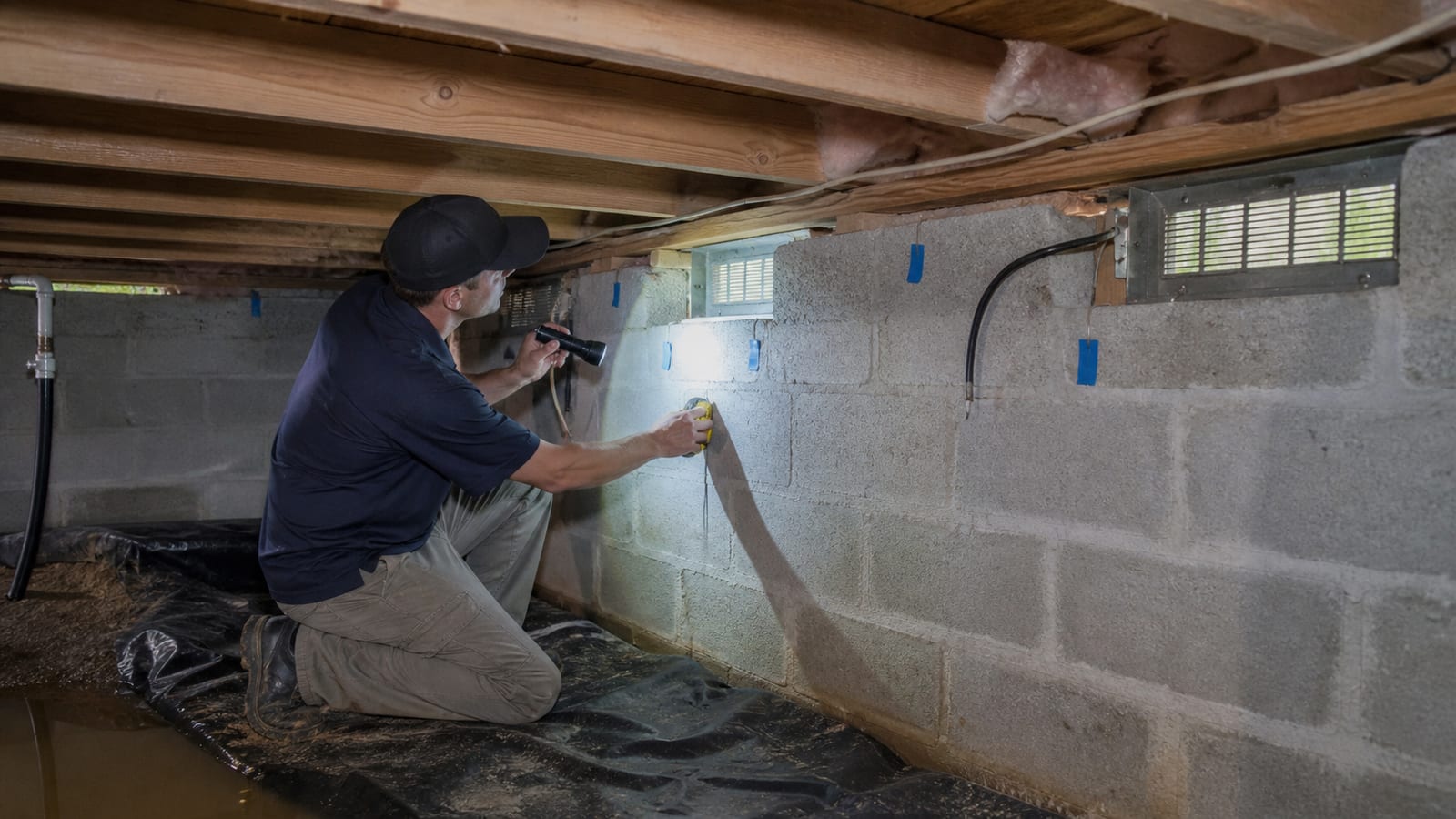
Test a fan by documenting conditions before installation, changing one variable, and comparing air and material trends under similar weather. Use stable sensor locations, note fan cycles and HVAC operation, inspect for condensation or wet materials, and verify replacement-air paths. A lower reading beside the fan does not prove whole-space improvement.
Begin with at least several baseline observations that include:
- crawl-space temperature and relative humidity;
- outdoor temperature, humidity, and dew point if available;
- sensor location and accuracy notes;
- recent rainfall;
- standing water or wall staining;
- ground-liner condition;
- duct and pipe condensation;
- insulation and visible framing condition;
- access and vent positions;
- HVAC and dehumidifier status.
After the fan starts, leave sensors in place. Add a labeled sensor near the suspected problem area only if needed. Record whether the fan exhausts, supplies, or circulates air and when it operates. Look for a repeatable change across zones, not one favorable spot reading.
Watch recovery after humid weather and rain. A fan may lower humidity during a dry day but raise it overnight or after a storm. Compare material condition too. Wood and insulation can remain damp after air readings fall.
If the data becomes worse, stop and reassess according to equipment instructions and safety requirements. Do not keep increasing airflow to force the number down. The ideal crawl space humidity guide explains why trends and physical evidence are more useful than reacting to one percentage.
Is a crawl space fan the same as a dehumidifier?
A crawl space fan and a dehumidifier perform different functions. A fan moves air or exchanges it with another space. A dehumidifier condenses water vapor from air and routes the collected water away. Either device can fail to control conditions when drainage, soil vapor, air leakage, wet materials, or equipment placement remain unresolved.
A dehumidifier has operating limits, airflow needs, filter maintenance, condensate drainage, and power requirements. It is not a substitute for bulk-water management. A fan has pressure effects and relies on replacement air. It is not a substitute for vapor control.
In some designs, multiple components work together. The key is that each has a defined role:
- drains collect and route liquid water;
- a ground liner limits soil vapor;
- air sealing reduces uncontrolled exchange;
- a drying method manages remaining moisture;
- monitoring reveals changes;
- maintenance keeps the components functional.
The crawl space ventilation guide for North Carolina explains how powered airflow differs from vent covers and a closed air boundary.
The crawl space moisture-control service describes how these layers fit together. Comparing fan and dehumidifier labels without reviewing the system can lead to equipment being blamed for a problem outside its job.
How does Carolina Encapsulation Company evaluate a fan request?
Carolina Encapsulation Company can evaluate a fan request by inspecting the current crawl-space design, reported humidity pattern, water paths, soil coverage, vents, access, and existing equipment before recommending airflow changes. A free inspection is used to connect the symptom to the system rather than to prescribe a fan from one remote reading.
The practical observation behind this process is straightforward: airflow follows pressure, not the homeowner’s intended arrow on a diagram. A fan installed in one vent may pull from a floor gap, another vent, or an uncovered soil edge. That detail cannot be settled by the fan label.
The inspection can record:
- fan type and direction;
- grille and screen blockage;
- control and sensor location;
- open vents and access gaps;
- ground-liner condition;
- exterior water near openings;
- condensation on ducts and pipes;
- drain, sump, and dehumidifier status;
- zones that respond differently.
There are limits. The company should not claim that a visual review measures whole-house pressure, proves combustion safety, diagnoses concealed electrical work, or guarantees a humidity outcome. Specialized testing or another trade may be needed when mechanical, electrical, structural, or combustion issues fall outside the observed crawl-space scope.
What should you check when an existing fan is not working?
Check an existing fan by starting with safe, visible conditions: power indication, control settings, obstruction, damage, unusual sound, weather exposure, and sensor placement. Then compare humidity and material conditions across the crawl space. Do not open powered equipment, handle wet wiring, or assume silence proves the fan caused the moisture problem.
Use a simple review order:
- Confirm the timestamp and condition that triggered the concern.
- Look for water near the fan, cord, control, or outlet.
- Check whether the grille is blocked by lint, vegetation, mud, or nesting.
- Observe whether shutters or dampers move freely from a safe position.
- Confirm the control sensor has not shifted beside a dry or wet surface.
- Note whether the access or other vents changed.
- Inspect water, soil vapor, and wet materials that the fan cannot correct.
- Follow manufacturer instructions for resets, cleaning, and service.
If electrical components are wet, damaged, sparking, hot, or producing an unusual odor, do not touch them. Arrange appropriate electrical evaluation. A moisture-control inspection can document the crawl-space context, but it should not bypass electrical safety.
Frequently asked questions about crawl space ventilation fans
These answers address common fan controls, operation, sizing, and limitations. They cannot determine the right airflow or pressure for a specific house without measurements and an inspection of replacement-air paths.
Should a crawl space ventilation fan run all the time?
Not automatically. Continuous operation may pull humid air, increase pressure effects, waste energy, or run after conditions have changed. Operation should follow the fan’s intended design, controls, and equipment instructions. Verify performance across weather conditions and inspect materials rather than assuming longer run time always creates a drier result.
Will a humidistat make a crawl space fan safe?
A humidistat adds a control input, but it does not evaluate every relevant condition. Sensor accuracy, placement, temperature, outdoor dew point, rain, and replacement-air paths still matter. A local high reading can trigger airflow that imports more moisture. Test the complete system and keep the sensor in a representative location.
Can a fan remove musty odors?
A fan may dilute or move odor, but odor reduction does not prove the moisture source is corrected. Damp soil, wet insulation, wall entry, pests, drains, or microbial growth may remain. Trace the source and correct moisture rather than exhausting air as the only response. Avoid directing crawl-space air toward occupied rooms.
How large should a crawl space fan be?
Fan selection depends on the intended design, actual airflow resistance, replacement-air routes, controls, and building conditions. Floor area alone is not enough. An oversized fan can create stronger pressure effects, while an undersized or obstructed fan may move little air. Use equipment instructions and project-specific design rather than a universal shortcut.
Can I install a fan in one foundation vent?
Physical fit does not establish that the location is appropriate. The fan needs safe power, weather protection, a defined airflow direction, suitable replacement air, and monitoring. Installing it in one opening can short-circuit air through a nearby vent while remote zones remain unchanged. Review the full crawl-space layout first.
Why did humidity rise after the fan was installed?
The fan may be importing humid outdoor air, pulling vapor through exposed soil, changing air movement from the home, or operating during wetter weather. The sensor may also sit in a different air stream. Preserve baseline data, inspect for water and condensation, verify airflow paths, and reassess the control strategy.
A fan is an airflow tool, not a complete moisture system. If humidity persists, condensation appears, or a fan’s result changes with weather, call Carolina Encapsulation Company at 704-207-9348 or request a free crawl space inspection to trace water, vapor, and replacement-air paths before changing the equipment.
How this applies in Lillington, NC
For homeowners in Lillington, NC, use this topic as a way to organize observations before selecting work. Carolina Encapsulation Company serves Lillington, NC and surrounding Triangle communities, but the appropriate scope still depends on the water, moisture, materials, access, and equipment found at the property. Compare the crawl space vent sealing air sealing with the Crawl Space Ventilation in North Carolina: Vents, Fans, and Moisture in Clayton, NC before choosing a property-specific next step.