Short answer
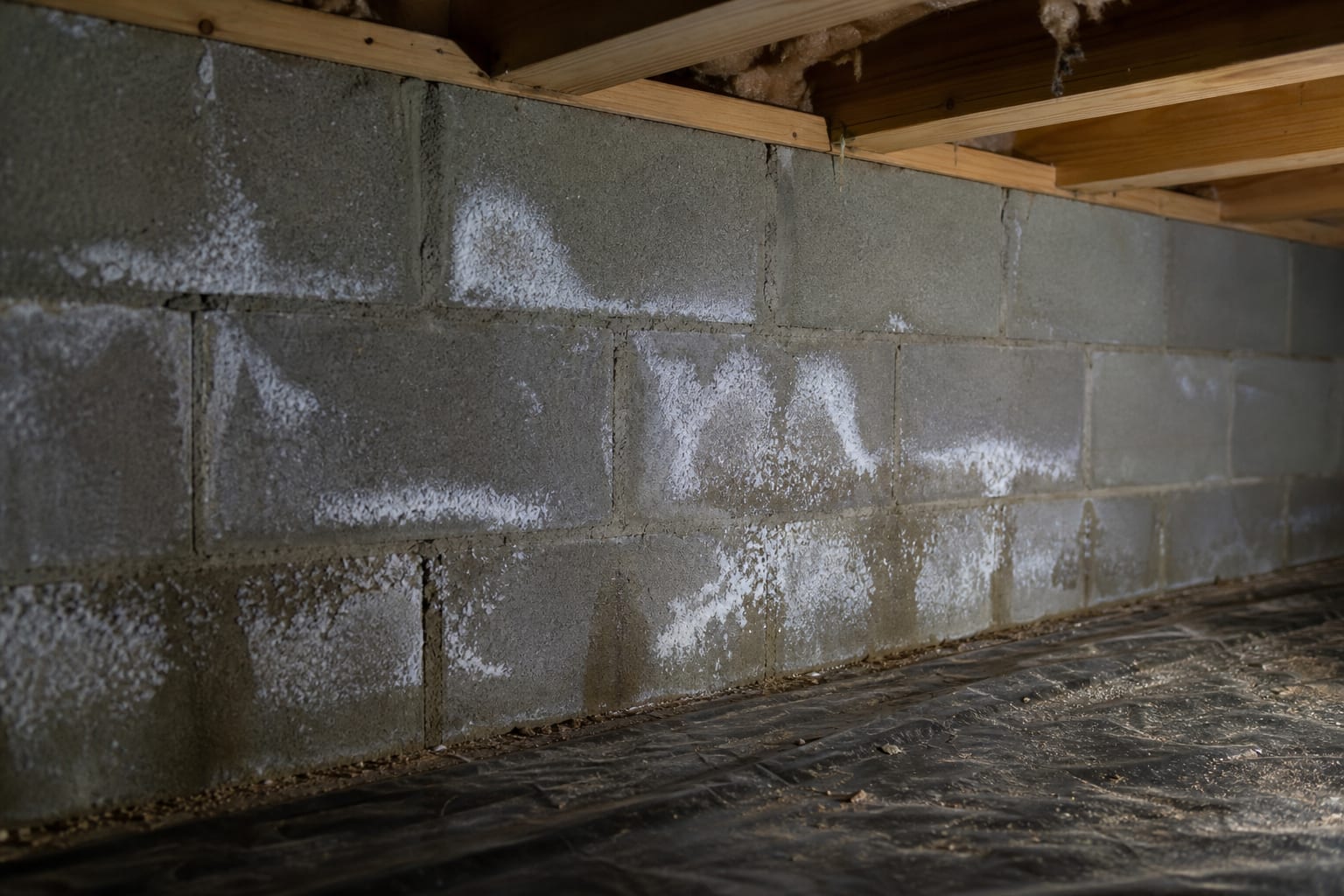
White powder on a crawl space block wall may be efflorescence, a deposit of soluble salts carried through masonry by moisture, but appearance alone cannot rule out fungal growth, residue, or another material. Efflorescence is a moisture clue even when the deposit itself is not the main problem. Do not identify or treat the surface from a photo. Document its texture, location, wall condition, weather pattern, and nearby water, then inspect the moisture path before cleaning or coating the block.
What efflorescence is
Concrete block, mortar, brick, and other porous masonry contain or contact soluble minerals. When water moves through the material, it can dissolve salts and carry them toward an exposed surface. As the water evaporates, the salts remain as a light-colored haze, powder, crystals, or crust. That surface deposit is called efflorescence.
The deposit often appears white, but its exact texture and color vary. It may follow mortar joints, form a band at a recurring wet height, or appear below a crack or penetration. It can return after removal if moisture continues moving through the wall.
The National Park Service describes efflorescence as a whitish haze of soluble salts on masonry and notes that it can serve as a warning that water has found an entry path. EPA’s mold investigation material also notes that a white soluble fibrous material in a crawl space may be alkaline salts rather than mold, while still indicating that moisture deserves further inspection.
That is the key point: “not mold” would not mean “no moisture problem.”
Why a crawl space block wall develops white deposits
Moisture can reach a foundation wall from several directions:
- Rainwater concentrated by gutters or downspouts
- Surface water held against the foundation by grade
- Saturated soil outside the wall
- Groundwater moving through or beneath masonry
- A plumbing or exterior-faucet leak
- Condensation on a cool masonry surface
- Water released from an adjacent material or penetration
The standing water problem page covers bulk-water symptoms. A dry-looking floor does not exclude moisture movement through the wall because small amounts can evaporate before forming a puddle.
Efflorescence requires a salt source, moisture to dissolve and carry it, a path through pores, and evaporation at the surface. Changing any one part can change the visible deposit. For example, a sealed coating may hide surface crystallization without stopping moisture within the wall. Salts can then accumulate below the surface or emerge at a nearby joint.
Why appearance cannot confirm mold
Fungal growth can appear in many colors and textures. Dust, mortar residue, pest debris, insulation fibers, paint failure, and mineral deposits can resemble growth in a low-light crawl space. A phone image changes color and contrast, and a flashlight can make crystals look fuzzy.
A remote observer cannot reliably identify the substance from:
- White color
- A circular patch
- A fuzzy edge in a photo
- Location near a vent
- Whether it wipes away
- Odor alone
The crawl space mold and fungal growth page explains the broader moisture relationship without treating every stain as a confirmed organism.
EPA guidance emphasizes investigation of water leaks and damp odors. The practical question is not only “what is the white material?” It is also “why is this surface wet enough for a deposit or growth to appear?”
Visual clues that help organize an inspection
The following observations can guide next steps, but none is a laboratory identification.
Pattern on the masonry
Efflorescence often follows the pores and joints through which moisture evaporates. It may create a broad haze, a horizontal band, isolated crystals, or a fan below a penetration. Repetition at the same location after rain strengthens the moisture-path evidence.
Growth may be patchy and can occur on dust, paint, wood, paper, insulation, or organic debris near the wall. It is not limited to masonry joints. Still, pattern alone cannot settle the question.
Surface texture
Mineral deposits may look powdery, chalky, crystalline, or crusted. Some are loose; others are bonded. Fungal structures can look fuzzy, spotted, slimy, or stain-like, but many do not fit a simple visual category.
Do not touch an unknown substance bare-handed or create dust to test it.
Relationship to rain
A deposit that expands or reappears after storms may point toward exterior water or saturated soil. Photograph it before rain, soon after safe access is possible, and after a dry period. Include a fixed reference for scale.
Relationship to plumbing and equipment
If the area sits below a water line, exterior faucet, drain, HVAC condensate route, or dehumidifier discharge, check timing with equipment or fixture use. A plumbing source can wet masonry regardless of weather.
Adjacent material condition
Look for damp wood, rust, peeling coating, soft mortar, mud lines, wet insulation, soil erosion, or a musty odor. These conditions help describe the extent and urgency even when the white material remains unidentified.
A safe documentation checklist
Do not begin by scrubbing the wall. Cleaning can erase the map that shows where water moved.
Record:
- The exact wall, corner, height, and dimensions.
- Whether the material is on block faces, mortar joints, paint, wood, or several surfaces.
- The weather during the previous days.
- Visible water, dark masonry, cracks, penetrations, or staining.
- Exterior conditions at the matching location.
- Humidity and meter location if a reliable meter is available.
- Odor location and timing.
- Earlier photos or reports showing whether the pattern is new.
Use wide photos for location, medium photos for the wall pattern, and close photos for texture. Avoid flash-only closeups that lose the surrounding context.
Trace the moisture path before choosing a treatment
Check roof runoff
Look at gutters and downspouts above and uphill of the deposit. Overflow, disconnected elbows, blocked underground lines, and short outlets can saturate foundation soil. The foundation drainage improvements page connects these exterior observations to crawl space water management.
Check grade and hard surfaces
Soil, patios, steps, and driveways can direct water toward one wall. Landscape edging or settled backfill can hold a shallow pool that disappears before the crawl space is inspected.
Check wall details
Map cracks, mortar changes, penetrations, previously sealed vents, access openings, and additions. Water may enter behind one surface and emerge at a different joint.
Check plumbing and drains
Look above and along the wall for supply lines, drain piping, hose connections, condensate lines, and dehumidifier drainage. Do not handle wet electrical equipment or disturb a pressurized line.
Check the floor and low points
Mineral deposits on the wall may occur with water below a liner or at the wall-floor joint. Do not cut encapsulation material. Document soft, raised, or shifting areas and have the sealed system evaluated.
Why coating the wall can hide evidence
Waterproof coatings, paint, and sealers have specific substrate and moisture requirements. Applying one over an unidentified deposit can trap salts, lose adhesion, blister, or move the visible moisture to another area. It can also make later diagnosis harder.
The crawl space waterproofing page is the primary service destination for bulk-water control. A coating, when appropriate, should be selected as one part of a verified water plan, not as a cosmetic response to white powder.
Cleaning depends on the material and wall condition
Do not mix cleaning chemicals in a crawl space. Avoid aggressive wire brushing, grinding, or pressure washing that can damage block faces, mortar, coatings, liner, or nearby materials. Creating airborne dust in a confined area is also undesirable.
For a small confirmed mineral deposit on sound uncoated masonry, a qualified professional may use a method appropriate to that masonry and then watch for recurrence. Historic masonry guidance often favors gentle methods, but a modern crawl space wall still needs material-specific evaluation.
If growth is confirmed or strongly suspected, moisture correction comes first. Cleaning scope depends on the affected material, area, access, and whether porous materials can be cleaned or need removal. A generic bleach application is not a substitute for that evaluation.
When testing may or may not help
Not every white deposit requires sampling. EPA notes that when visible mold is present, sampling is often unnecessary for deciding that moisture and growth need attention. In an uncertain case, a qualified inspector may use close examination, moisture measurements, material behavior, or testing when the result would change the decision.
Ask what a proposed test will answer:
- Will it distinguish salts from biological material?
- Will the result change the moisture investigation?
- Is the sample representative of the actual area?
- Who will interpret it?
- Will source correction proceed regardless?
Testing should not delay correction of an obvious active leak.
What recurrence tells you
A wall cleaned to bare masonry can develop new efflorescence because salts and moisture remain. Photograph the cleaned boundary and date it. If the deposit returns, note which edge appears first and how it relates to rain or plumbing use.
Recurrence can help locate:
- A persistent exterior saturation zone
- A wall crack or joint
- A periodic plumbing leak
- A condensate route
- Moisture rising from below
- A seasonal evaporation pattern
It does not prove that the wall is structurally damaged. Crumbling mortar, spalling block, bowing, displacement, or widening cracks are separate conditions that call for qualified structural or masonry evaluation.
Preserve the wall for future comparison
After the source and surface are evaluated, keep a simple wall record. Mark the photo rather than the masonry, and note the boundary, date, rain history, and any cleaning method used. Repeat the same wide and close views after a comparable storm and after a dry period.
Do not stack materials against the wall or cover the area with permanent storage. Keep the adjacent liner edge, penetrations, joints, and visible wood accessible. If a later coating or sealed detail is proposed, photograph the bare condition first and retain the product and preparation record. That history helps distinguish a new deposit from one that was never fully removed and shows whether the moisture pattern moved after exterior or drainage work.
Limitations and when to schedule an inspection
A homeowner can document the deposit, compare weather, review gutters and grade, check visible plumbing, and note adjacent water. Identifying unknown material, measuring concealed moisture, evaluating masonry damage, and selecting cleaning or waterproofing methods require professional judgment.
Schedule an inspection when the deposit returns, spreads, appears with active water, or occurs beside soft wood, wet insulation, strong odor, deteriorating masonry, or repeated high humidity. Stay out when standing water is near electrical equipment, contamination is possible, or the wall or supports appear unstable.
For an evaluation that connects the wall surface to the larger crawl space, request a free inspection and preserve the photos before cleaning.
Frequently asked questions
Is white powder on a concrete block wall always efflorescence?
No. Efflorescence is common, but mortar residue, dust, paint failure, fibers, fungal growth, and other materials can look similar. Location, texture, moisture evidence, and qualified examination matter.
Does efflorescence mean the wall is leaking?
It indicates that moisture moved through or along masonry at some point. The amount and source may range from vapor and intermittent dampness to active seepage. Trace the water path before assigning the term “leak.”
Can mold be white?
Some growth can appear light-colored, but color does not identify it. Do not use a photo or simple wipe test as proof. Investigate moisture and obtain qualified evaluation when identification affects the work.
Can I paint over efflorescence?
Painting without correcting moisture and preparing the masonry can hide evidence and lead to poor adhesion or recurrence. The wall condition, coating, and water source should be reviewed first.
Should efflorescence be removed immediately?
Document it first. The deposit may help locate moisture movement. Cleaning method depends on the masonry and coating, and repeated deposits will return if the water path remains.
Sources and further reading
- U.S. Environmental Protection Agency: Finding Mold and Moisture
- U.S. Environmental Protection Agency: Mold Course Chapter 2
- U.S. Environmental Protection Agency: A Brief Guide to Mold, Moisture and Your Home
- National Park Service: A Glossary of Historic Masonry Deterioration Problems and Preservation Treatments
- National Institutes of Health: Efflorescence in Masonry Walls Technical Bulletin
How this applies in Clayton, NC
In Clayton, NC, document water timing, roof runoff, grade, the entry point, the low point, and the discharge route before naming a drainage solution. A wet area can be where water collects rather than where it entered, so the location of each observation matters. Compare the crawl space mold fungal growth with the Crawl Space Drainage Systems: From Water Entry to Discharge in Garner, NC before choosing a property-specific next step.