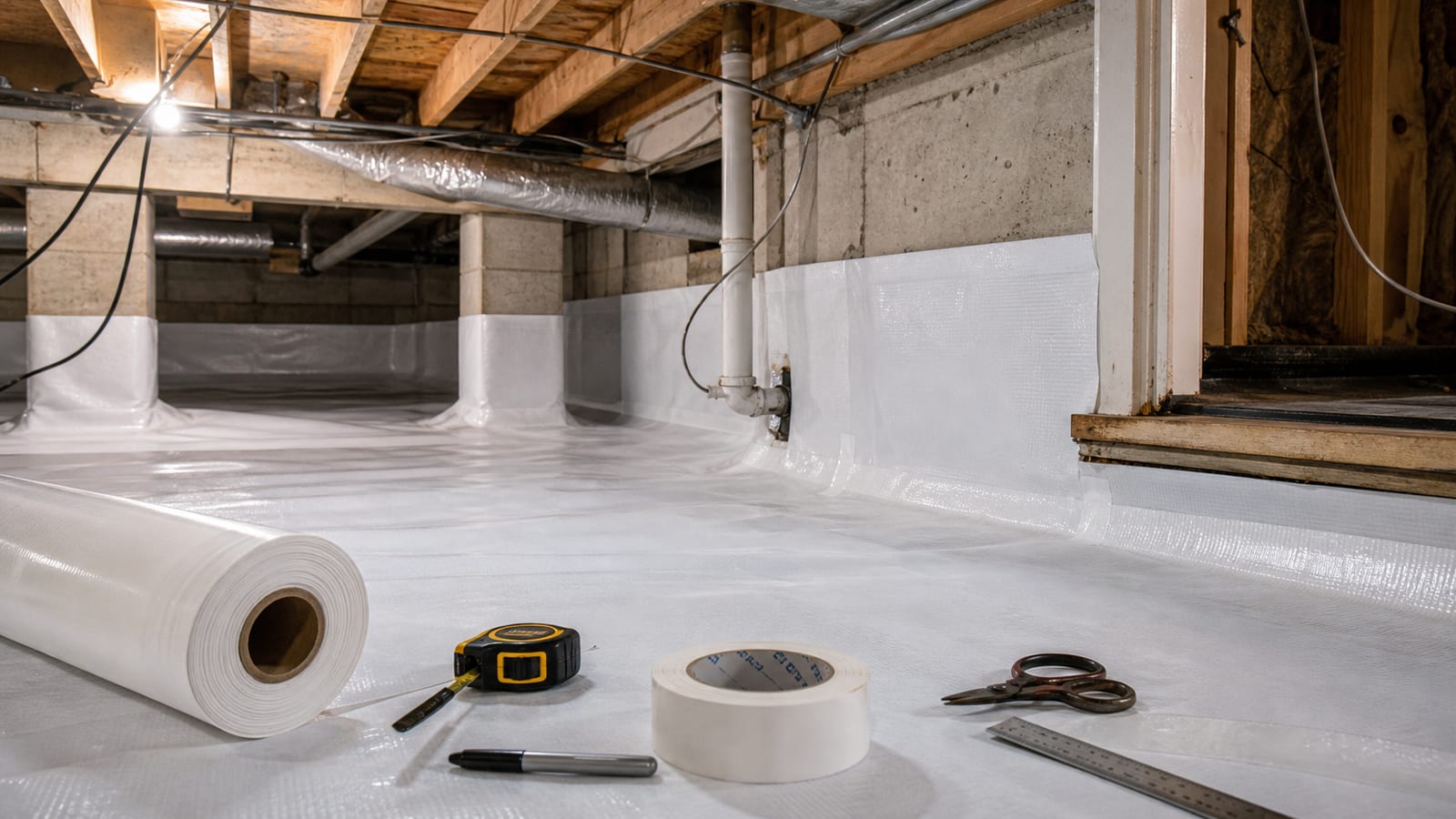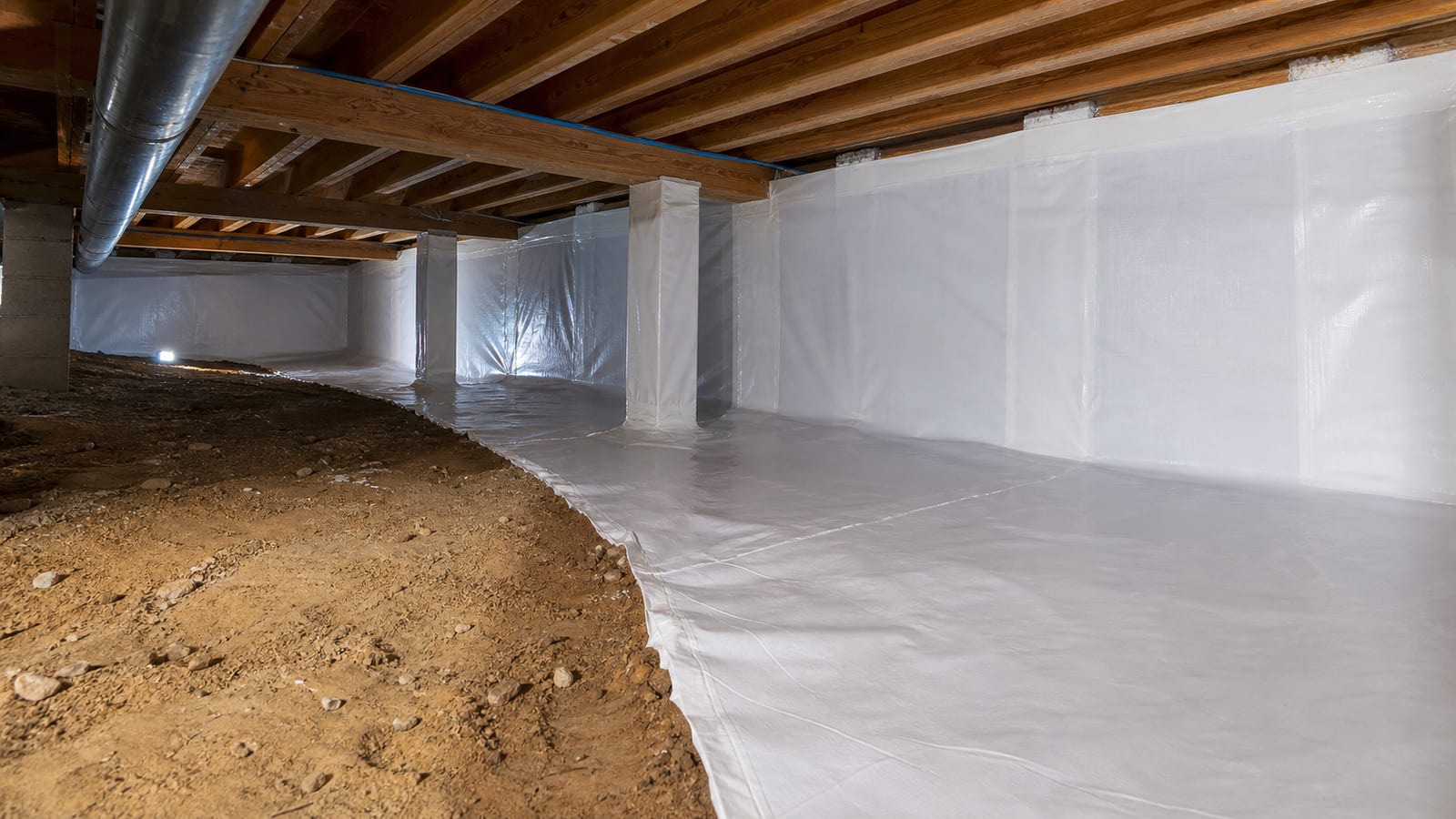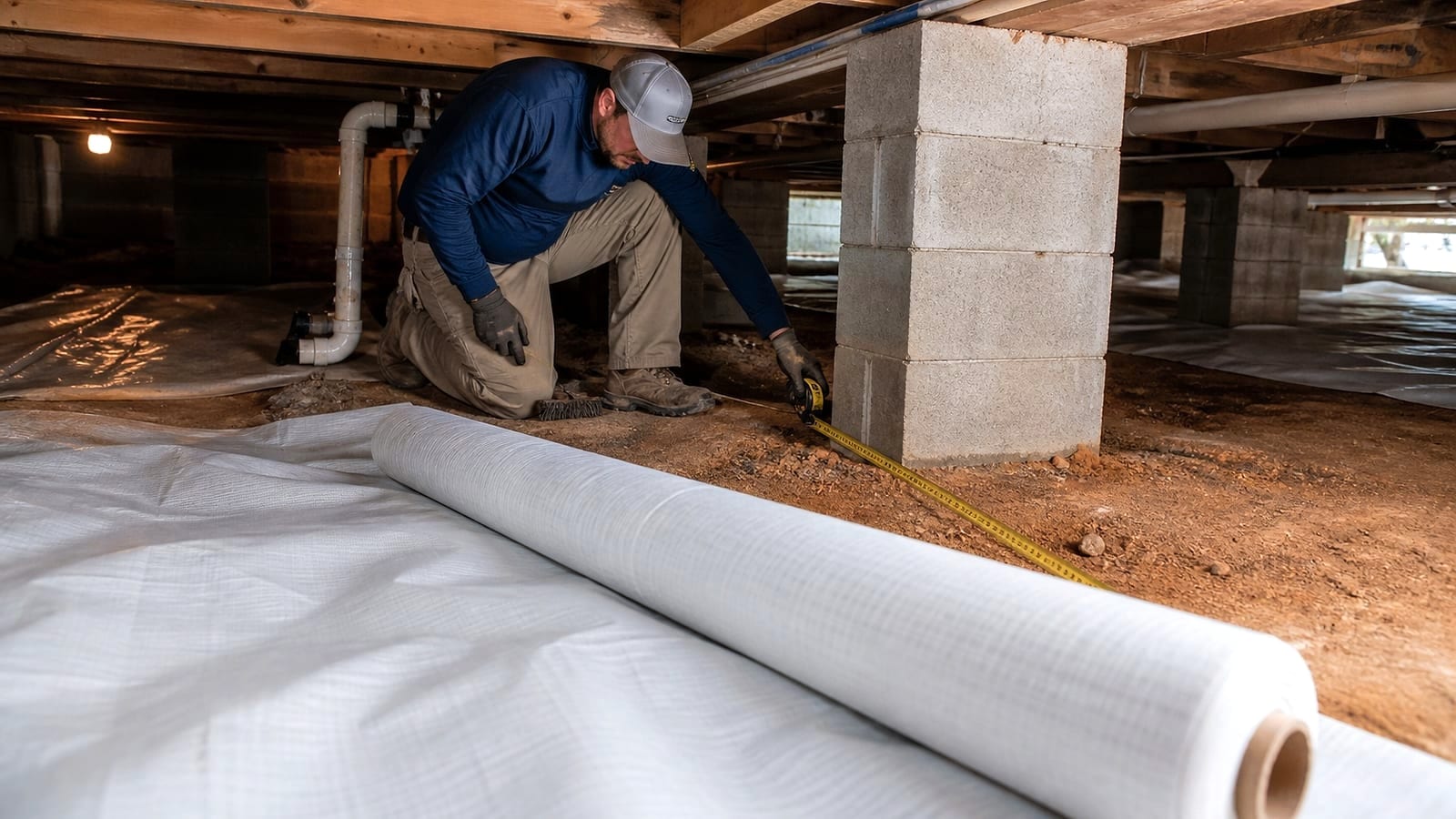
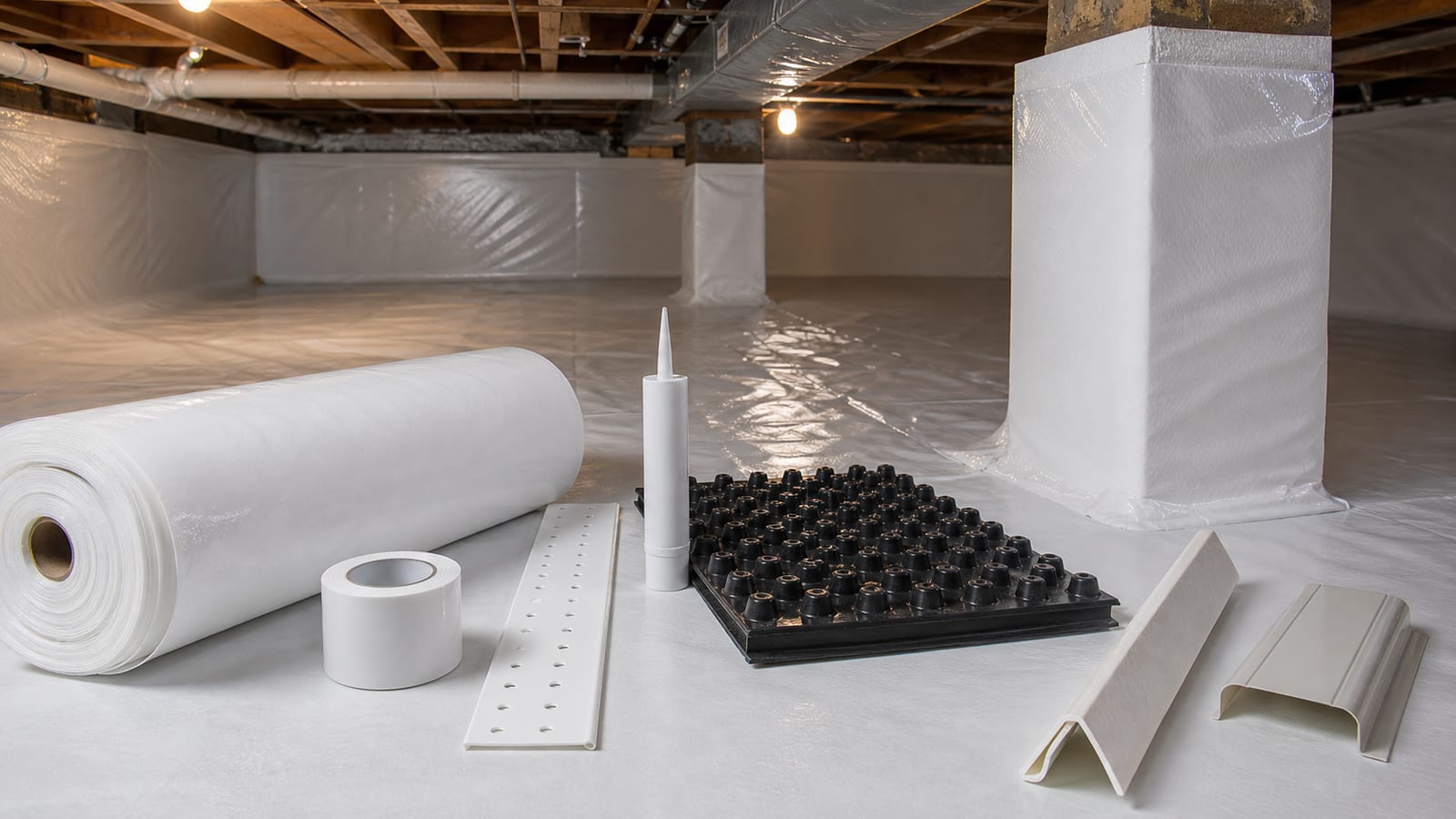
Crawl space encapsulation materials work as a system: liner limits ground vapor, seam materials connect sections, fasteners and sealants handle transitions, drainage layers manage liquid water, and protective materials reduce damage. No single thickness or product description proves a complete installation. Each material should have a defined job, compatible surface, and inspectable detail.
Material selection comes after moisture diagnosis. A dry dirt floor, recurring wall seepage, sharp rubble, irregular piers, frequent service traffic, and wet insulation create different requirements. The useful question is not “What is the strongest material?” It is “Which layer addresses this observed condition, and how will it remain continuous?”
What materials are used in crawl space encapsulation?
Common materials include polyethylene or reinforced liners, seam tape, compatible sealant, mechanical fasteners, termination strips, vent closures, access-door materials, drainage fabric or aggregate, pipe or channel components, insulation, and protective walkway layers. The exact list depends on water, air, vapor, thermal, and service-access needs documented in the crawl space.
The crawl space encapsulation system guide explains the control layers those materials serve. A material list should identify:
- the ground-vapor boundary;
- wall and pier transitions;
- seam connections;
- termination and attachment;
- vent and access closures;
- utility penetration details;
- drainage beneath or beside the liner;
- protection at sharp or high-traffic locations;
- humidity monitoring and drying equipment;
- repair materials retained for maintenance.
Avoid treating optional layers as universal. A crawl space without recurring liquid water may not need the same drainage assembly as one with wall seepage. A service route may need protection that a low-traffic area does not. Inspection should decide.
How does liner thickness affect performance?
Liner thickness can affect puncture resistance, stiffness, handling, and durability, but thickness does not determine performance by itself. Reinforcement, surface preparation, seams, wall attachment, sharp edges, traffic, and water beneath the material also matter. A thicker liner with open transitions can be less complete than a carefully detailed compatible system.
Mil is a unit of thickness, not a quality grade. Comparisons among 6-mil, 12-mil, and 20-mil materials should consider actual use rather than assuming the largest number always belongs everywhere. The vapor barrier thickness comparison provides a side-by-side framework.
The vapor barrier installation service provides additional context for floor coverage, repair, and the inspection steps that should precede material selection.
Questions to ask include:
- Is the material reinforced?
- How resistant is it to tearing around fasteners?
- Can it conform around piers and corners?
- What preparation does the manufacturer require?
- Which tape and sealant are compatible?
- Will technicians regularly cross the surface?
- Can later repairs use matching materials?
The substrate matters. Broken masonry, cut wire, roots, scrap wood, and sharp stone can damage a heavy liner. Preparation and selective protection may deliver more value than thickness alone.
What job do tapes, sealants, and fasteners perform?
Tapes connect compatible liner surfaces, sealants address selected transitions, and fasteners hold material to suitable substrates. They are not interchangeable. Each relies on surface condition, installation method, and movement. Using one adhesive everywhere can lead to lifted seams, failed masonry attachment, or gaps around irregular penetrations.
Seam tape generally performs best on clean, dry, compatible liner surfaces with adequate overlap and pressure. Dust, condensation, folds, and tension can weaken adhesion. Tape should not bridge a puddle or substitute for missing material.
Sealant can conform to some irregular surfaces, but it needs the right joint shape and compatible substrates. It should not be used as a thick filler for large voids or applied over loose dirt and flaking masonry.
Mechanical fasteners and termination strips resist pull-away at walls. Their spacing, substrate, and interaction with the liner matter. A fastener driven through unsupported material can create a tear point. Wall details should also preserve any necessary inspection area and avoid hiding active water.
What are the top 6 material details that deserve close inspection?
The most important material details are seams, corners, piers, wall terminations, penetrations, and traffic routes. These locations interrupt broad flat surfaces and concentrate movement or wear. Inspecting them closely reveals more about system continuity than judging the center of a clean liner.
- Seam overlap and adhesion. Look for full contact, wrinkles, contamination, and tension that could pull sections apart.
- Inside and outside corners. Material must change direction without leaving a hidden pocket or unsupported tear point.
- Pier transitions. Multiple cuts and connections should remain continuous while preserving structural visibility.
- Wall termination. Attachment should suit the masonry and the planned inspection clearance.
- Utility penetrations. Pipe and wire details need allowance for shape and normal movement without oversized gaps.
- Service pathways. Routes to plumbing, HVAC, drains, and equipment need protection from repeated foot and tool traffic.
Take finished photographs of every detail category. Wide views establish location, and close views record how it was built.
How do drainage materials differ from vapor-control materials?
Drainage materials move liquid water, while vapor-control materials limit moisture diffusion from soil and other surfaces. A liner does not create a drainage destination, and a drain does not stop ground vapor. Some systems place drainage components beneath or beside the liner, but their purposes remain distinct and both need maintenance access.
Drainage materials may include perforated pipe, collection channel, washed aggregate, filter fabric, basins, pumps, check valves, alarms, and discharge piping. Their selection depends on water source, sediment, elevation, outlet, power, and service requirements.
The liner above a drainage route should not prevent inspection or trap water in unintended pockets. A raised or floating liner after rain can indicate water beneath it. Cutting the liner to release water without understanding the route can damage the vapor boundary and leave the source unresolved.
Exterior drainage remains relevant. Gutters, downspouts, grade, and discharge location influence how much water reaches the foundation. Material inside the crawl space should not be asked to compensate for avoidable exterior loading.
What materials are used to close vents and access points?
Vent and access materials create durable parts of the intended air boundary. They may include rigid closure panels, framing, compatible sealants, gaskets, weather-resistant door materials, and attachment hardware. The details should resist movement and moisture while keeping the access usable and avoiding conflicts with utilities or safety requirements.
A loose insert is not the same as a sealed closure. Gaps around edges can remain air pathways, and absorbent or fragile materials can deteriorate. The access door should close consistently, shed exterior water, and avoid cutting or pinching the liner.
Closing vents changes crawl space operation. It should occur within a complete water, vapor, air, and humidity plan. The U.S. Department of Energy’s unvented conditioned crawl space overview describes the connected building-science approach rather than vent closure as an isolated product.
How should encapsulation materials preserve inspection access?
Encapsulation materials should leave plumbing, wiring, framing, supports, drainage, equipment, and required pest observation areas accessible. Removable or clearly documented details are preferable where future service is expected. Material should not conceal an unresolved stain, damaged member, wet area, or critical connection merely to create a uniform finish.
Plan routes before installation. A technician may need to reach:
- a plumbing shutoff or joint;
- an HVAC connection;
- a sump basin or drain;
- a dehumidifier filter and condensate line;
- structural supports;
- electrical junctions that must remain accessible;
- termite observation areas;
- the far side of piers and foundation walls.
Storage should not be placed over the finished liner. Cardboard, tools, scrap material, and heavy items can create punctures, obstruct equipment, and hide water.
How does Carolina Encapsulation Company choose a material scope?
Carolina Encapsulation Company offers free inspections in Fuquay-Varina and surrounding Triangle communities. The inspection reviews water, soil, existing liner, walls, piers, vents, access, visible framing, insulation, drainage, and service routes. Material choices can then be tied to actual control layers rather than selected from one thickness claim.
There are limits to material judgment from appearance. A crawl space inspection cannot establish structural capacity, electrical safety, hidden plumbing condition, or laboratory material identity. Those issues may require another qualified professional. The encapsulation scope should work around that need and keep evidence accessible.
What should a material schedule include?
A material schedule should name each layer, its purpose, location, compatible connection method, preparation requirement, and maintenance access. It should also identify exclusions and the conditions that must be corrected before installation. This turns a product list into a buildable and reviewable scope.
Use a simple table in project records:
| Layer | Purpose | Location | Key detail |
|---|---|---|---|
| Ground liner | Limit soil vapor | Floor | Seams and edge transitions |
| Wall material | Continue boundary | Foundation walls | Termination and inspection clearance |
| Seam tape | Connect liner sections | Overlaps | Clean, dry, compatible surface |
| Sealant | Detail selected transitions | Irregular joints | Joint size and substrate |
| Fasteners | Resist pull-away | Wall terminations | Suitable masonry and spacing |
| Protection | Reduce wear | Service routes | Coverage without hidden water |
Do not list brand names or promise performance unsupported by the complete design.
Request a material-specific crawl space inspection
If you are comparing liners or trying to understand why a proposal includes drainage, wall coverage, or protective material, request a free inspection. Call 704-207-9348 or use the contact page to reach Carolina Encapsulation Company.
Frequently asked questions about encapsulation materials
These answers focus on the job each material performs. Product instructions and the actual crawl space conditions still control the final installation method.
Is white crawl space liner better than clear liner?
Color can affect visibility and the finished appearance, but it does not establish thickness, reinforcement, puncture resistance, seam quality, or compatibility. A light surface may make debris and some leaks easier to see. Compare documented material properties and installation details rather than treating color as a performance grade.
Does reinforced liner eliminate punctures?
No. Reinforcement can improve resistance to some tearing, but sharp debris, fastener details, repeated traffic, heavy objects, and later trade work can still cause damage. Prepare the substrate, protect service paths, keep storage out, and inspect after anyone enters. Retain compatible repair material for documented maintenance.
Can spray foam replace a crawl space vapor barrier?
Insulation and ground-vapor control serve different purposes. A thermal material installed in one part of the assembly does not automatically provide continuous soil coverage, drainage, wall transitions, or inspectable seams. Define the thermal, air, and vapor boundaries separately, then confirm how their materials connect without hiding required access.
Should liner be attached to every pier?
Pier treatment depends on the planned boundary, pier construction, moisture conditions, and inspection requirements. A transition may be included in a full encapsulation, but it should not conceal damage or block necessary observation. Ask how the detail remains continuous and repairable rather than assuming one universal pier method.
Can one tape work on liner, masonry, and wood?
Do not assume it can. Adhesives respond differently to polyethylene, dusty masonry, damp wood, temperature, pressure, and movement. Use materials intended for the specific substrates and follow preparation instructions. A connection that looks secure on installation day may not remain secure if compatibility and surface condition were ignored.
What material should be kept after installation?
Keep labeled compatible liner patches, seam material, product instructions, and a record of installed layers if the installer provides them. Store them outside the crawl space in a dry location. The record helps future repairs match the system without relying on appearance or introducing an unverified adhesive.
Encapsulation materials perform only when their jobs and connections are clear. Evaluate the source first, choose layers for water, vapor, air, and protection, and document every transition. A material schedule that preserves access is more informative than a promise based on thickness or a single product feature.
How this applies in Durham, NC
For homeowners in Durham, NC, use this topic as a way to organize observations before selecting work. Carolina Encapsulation Company serves Durham, NC and surrounding Triangle communities, but the appropriate scope still depends on the water, moisture, materials, access, and equipment found at the property. Compare the crawl space encapsulation with the Crawl Space Encapsulation Systems: A Component-by-Component Guide in Sanford, NC before choosing a property-specific next step.