A crawl space sump pump quote should describe a water-management system, not only a pump. Water has to reach a collection point, enter a basin, be moved through a discharge route, and leave in a way that can be observed and maintained. Power, access, equipment documentation, and the conditions that send water toward the basin all belong in the conversation.
That is why two pump proposals can be different without either one being automatically wrong. One may include interior collection work, basin placement, discharge routing, and electrical coordination. Another may address only a replacement pump because a working collection and discharge system already exists. A useful comparison begins by identifying which part of the system each proposal actually covers.
The sump pump installation cost-factors page explains the commercial scope. This guide provides a function-first way to read a proposal before comparing totals.
What should a sump pump installation quote explain?
A sump pump installation quote should explain the water conditions observed, collection route, basin location, equipment and power arrangement, discharge route, future service access, and any related drainage or moisture work that is separate. It should show how water reaches the pump and where it goes after the pump moves it.
Identify the water that needs to be collected
Start by documenting where water appears and when. Record whether it follows rain, long wet periods, plumbing use, a discharge problem, or an unknown pattern. Note the first visible wet area, the lowest area, wall stains, soil conditions, water depth if it can be observed safely, and whether a drain or basin already exists.
North Carolina State Extension includes checking sump-pump operation and floor-drain condition in its moisture checklist. That is a useful reminder that a sump pump is connected to a larger water path. The pump cannot solve a path that has not been traced, and a basin cannot collect water that does not reach it. Use the standing-water removal service page only to understand the immediate water-removal category, not as a substitute for identifying recurrence.
Explain the basin location
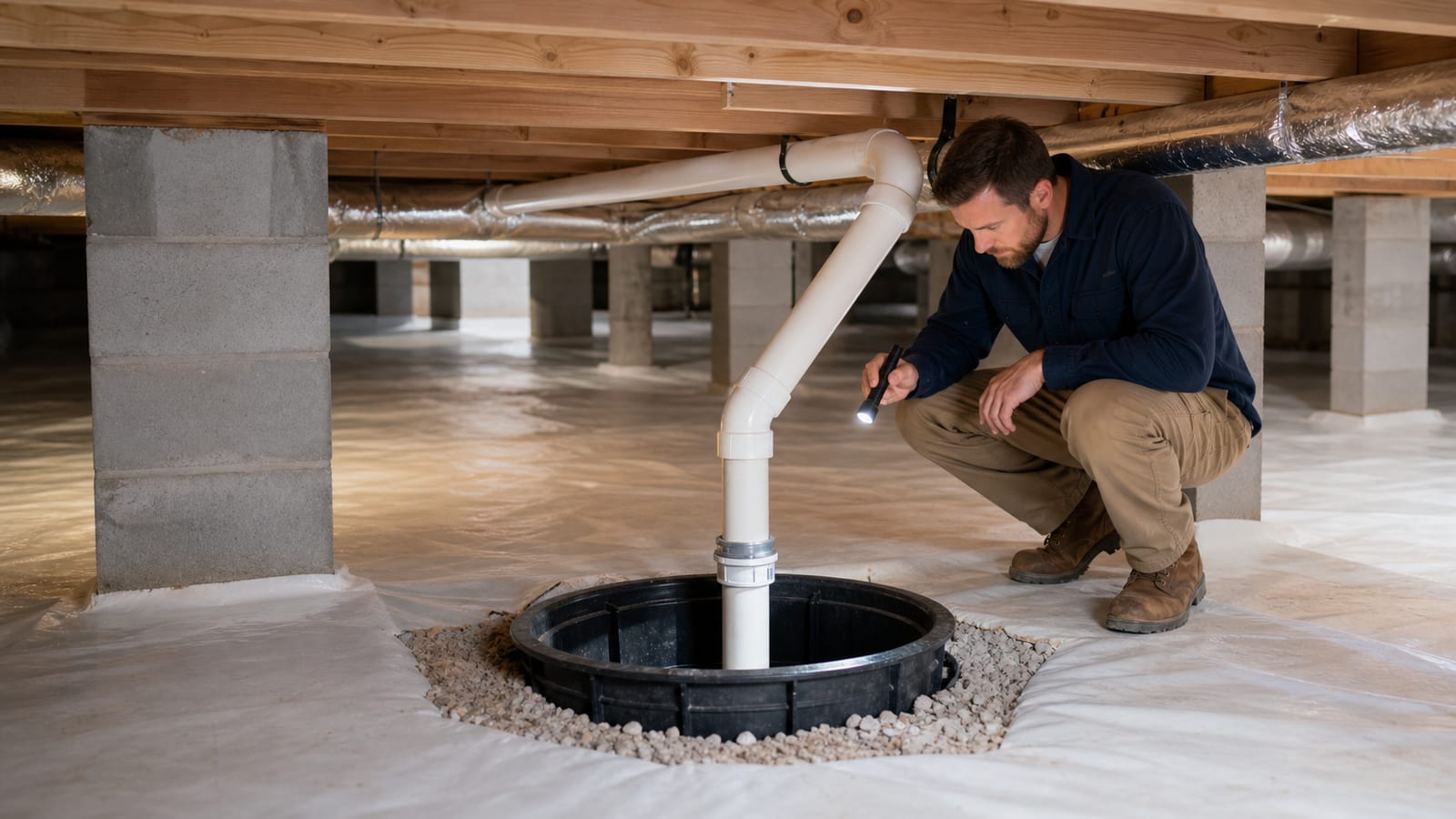
Ask where the basin will be placed and why it is located there. The answer should connect the location to a visible low point, drainage route, access, or collection need. It should also identify what is required to keep the basin, pump, check components where present, and service access reachable after the work is complete.
An accessible basin matters for future observation. A homeowner or service professional should be able to identify the equipment, see signs of overflow or disturbance, and reach the relevant parts without tearing up unrelated crawl space work. If the proposed location is behind a new liner, ducts, plumbing, or storage path, ask how maintenance access will be preserved.
Follow the discharge from pump to outlet
The discharge route needs to be as clear as the basin. Ask where the pump outlet connects, whether the line rises or travels across the crawl space, how it is supported, where it leaves the structure, and where the water is expected to go outside. The final outlet should be possible to locate and observe after operation or rainfall.
The acceptable discharge arrangement depends on the property, local requirements, site conditions, and the equipment. A general article cannot select it. It can help you notice when a proposal stops at the pump and does not describe the rest of the path. The foundation drainage improvements service page is the adjacent service context for exterior water routing.
How do collection, pumping, and drainage differ?
Collection brings water to a defined location. A sump basin receives the collected water. A pump moves it through a discharge route. Drainage and exterior water management can reduce or redirect water before it reaches the basin. These functions can work together, but each should be described separately in a quote.
Collection route
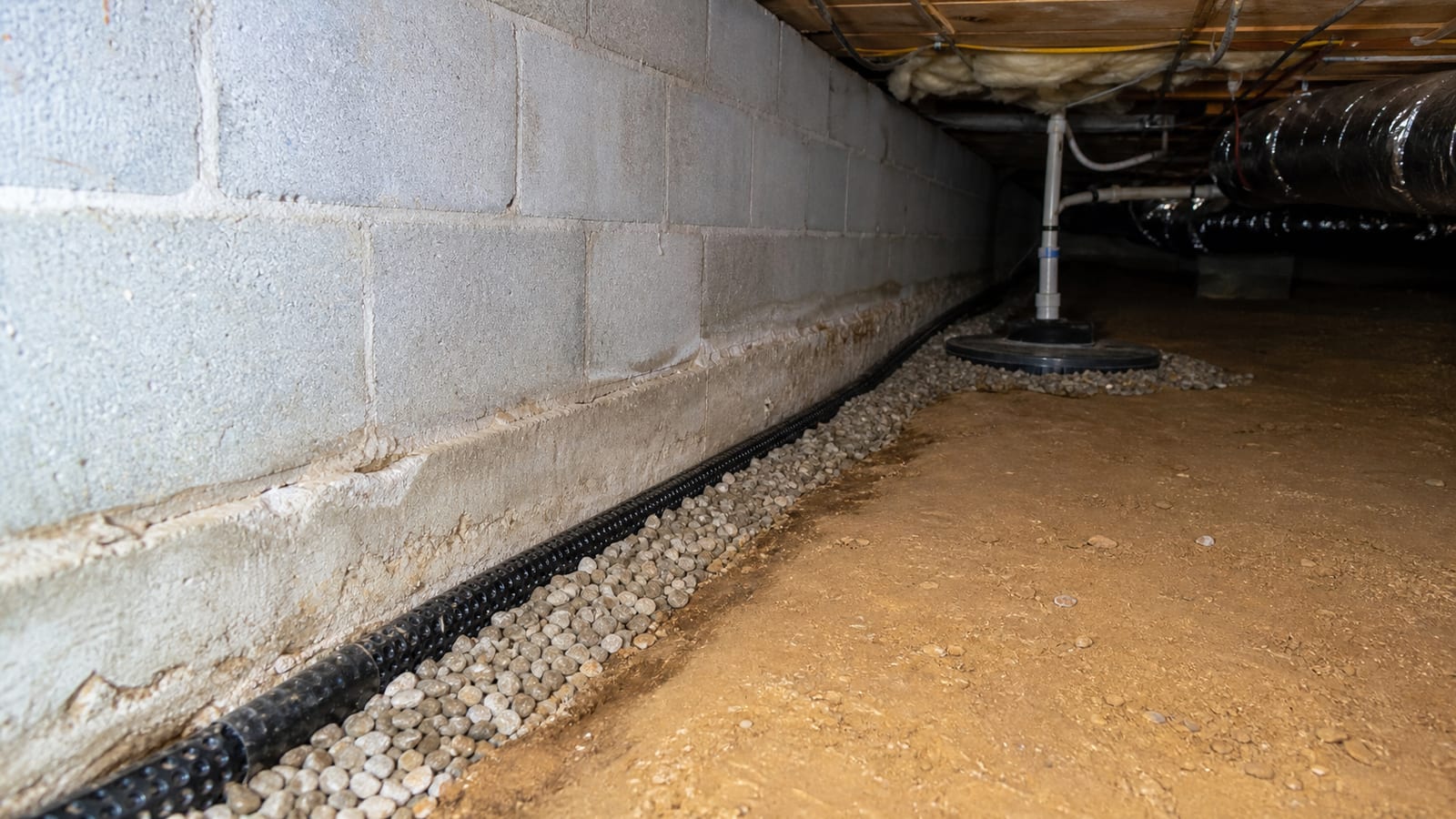
If the scope includes an interior drain or channel, ask how water reaches it, where it begins, where it ends, and how it relates to the observed wet areas. A drainage route may need to navigate low points, piers, equipment, or a liner. The interior French drain service page covers the collection function in more detail.
Pump and basin
The pump and basin serve a different role from the drain. Ask what equipment is included, where it will be located, how it is powered, what maintenance instructions come with it, and which visible components require future attention. Do not assume a particular alarm, backup, or control feature unless it is described for the actual equipment.
Discharge and exterior water path
The pump can move collected water, but the discharge needs a destination that does not create a new problem near the foundation. A proposal should identify the route and any exterior work it includes or excludes. Roof runoff, grade, downspouts, and surface water may still influence the amount of water the system sees.
The crawl space drainage system cost-factors guide gives a broader water-path checklist. Read it alongside a pump proposal when water entry, collection, and discharge are all part of the project.
Why do power and maintenance access affect the quote?
Power and maintenance access affect the quote because a pump is powered equipment with a basin, line, and outlet that require occasional observation. The scope should state how the unit is powered, which work is included, how the equipment is reached, and what the homeowner should monitor after the installation.
Electrical coordination
Ask whether the existing power arrangement is suitable for the proposed equipment, whether another trade is involved, and whether permit or inspection questions need verification. Do not assume every sump-pump installation has the same electrical needs. The work at a specific home depends on the equipment, existing conditions, and local authority.
Never enter standing water near electrical equipment or open an electrical component to test a pump. A safe homeowner observation is limited to visible conditions, such as water around the basin, the position of accessible piping, outlet condition, or an equipment status indication described in the actual manual. Report concerns rather than bypassing a switch, float, or alarm.
Routine visibility
Equipment behind a sealed access route, buried beneath stored items, or placed where a person cannot safely reach it is difficult to maintain. Ask how the basin, pump, filter or intake where applicable, discharge line, and outlet will remain visible. Keep manuals and model information with the crawl space records so a future service visit does not begin without context.
Outage and failure questions
Ask what happens if power is interrupted, a float or sensor stops working, a discharge line is blocked, or the outlet cannot be found. The answer depends on the actual system. A general discussion should not promise a backup or alarm that has not been installed. What matters is that the proposed equipment and maintenance plan are clear enough to verify later.
How should I compare sump pump proposals?
Compare the water evidence, collection route, basin, equipment, power, discharge, access, and exclusions before comparing totals. A pump replacement is not equivalent to a new collection-and-discharge system, and a proposal that includes a full drainage path is not equivalent to one that assumes the path already works.
Use this comparison list:
- What water condition did the inspection observe?
- How will water reach the proposed basin?
- Why is the basin located at that point?
- What pump, piping, power, and maintenance access are included?
- Where does the discharge go, and can the final outlet be found later?
- Are exterior water conditions, drainage, liner work, or repair part of this quote or a separate scope?
- What equipment instructions, service tasks, or warning signs are provided at handoff?
An itemized scope does not eliminate uncertainty, but it tells you which uncertainty remains. It also lets you see whether a proposal is designed around the observed water path or around a generic equipment label. The crawl space cost-planning pillar shows how pump scope fits beside the other crawl space functions.
What should I record before a sump pump inspection?
Record the timing and location of water, photos after rain when safe, exterior pooling, prior drain or pump work, equipment details, whether the pump has power, and the discharge outlet if you can see it without entering a hazardous space. Note whether water appears above or below a liner and whether a drain line is visible.
Keep the record factual. A note such as “water collected near the rear foundation wall after two days of rain” is more useful than trying to name the cause from a photo. Bring the record to a free inspection and ask the person reviewing the space to trace the path from entry to collection and discharge. You can request a free inspection when you are ready to connect those observations to a project-specific scope.
Frequently asked questions
Does a sump pump prevent all crawl space water problems?
No. A sump pump moves water that reaches its basin. It does not identify or remove every source of water, correct roof runoff, repair plumbing, seal an opening, or control ground vapor by itself. The water path and related conditions should be evaluated as separate functions.
Does a sump pump quote include a drain?
It may or may not. Some quotes address only equipment because a collection route already exists. Others include a basin and new interior drainage. Ask the proposal to state how water reaches the pump and whether collection work, discharge work, and equipment are each included.
Why does the discharge outlet matter?
The outlet is where collected water leaves the system. If it is unclear, blocked, hidden, or directs water back toward the foundation, the system may not perform as intended. A clear proposal identifies the route and lets the homeowner or service professional find it later.
Can I test a crawl space sump pump myself?
Follow the actual equipment manual and stay within safe visible checks. Do not enter standing water near electricity, open electrical components, defeat a float, or disconnect piping. If operation is uncertain, water is present, or the outlet cannot be verified, schedule a qualified inspection or service visit.
Is a sump pump the same as drainage?
No. Drainage collects or directs water to a chosen location. A sump pump moves collected water from a basin through a discharge route. One project can include both, but the quote should describe each function separately so the scope is clear and comparable.
Sources and further reading
- North Carolina State Extension: Mold and Moisture Checklist
- U.S. Environmental Protection Agency: A Brief Guide to Mold, Moisture and Your Home
- U.S. Department of Energy: Unvented, Conditioned Crawlspaces
How this applies in Apex, NC
For homeowners in Apex, NC, use this topic as a way to organize observations before selecting work. Carolina Encapsulation Company serves Apex, NC and surrounding Triangle communities, but the appropriate scope still depends on the water, moisture, materials, access, and equipment found at the property. Compare the crawl space sump pump installation cost with the Crawl Space Cost Planning in North Carolina: How to Compare Scope Before Price in Sanford, NC before choosing a property-specific next step.